Private Medical Insurance in Kenya (2026): How to Top Up SHA and Choose the Right Cover
HEALTH · HEALTH FINANCING
SHA is the foundation of health cover in Kenya, but it does not pay for everything, everywhere. Private medical insurance can fill the gaps, from private hospital bills to outpatient care. Here is how private medical insurance in Kenya works alongside SHA, the main types of cover, what to check, and the tax relief you may be able to claim.
Since the Social Health Authority (SHA) replaced NHIF, many Kenyans have asked the same question. If I already pay SHA, do I still need private medical insurance? The answer depends on where you want to be treated, how much risk you can carry, and your budget.
This guide explains where SHA’s cover typically stops and how private cover works alongside it. It also compares the options, from low-cost top-ups to full plans, and shows how to choose a policy that pays out when you need it.
Key takeaways
- SHA comes first. SHA pays at set rates at facilities it has contracted. Private insurers often expect SHA to pay its share before they pay the balance, so keep your SHA registration and contributions up to date.
- Private cover fills gaps: charges above SHA’s rates at private hospitals, treatment at facilities SHA has not contracted, and benefits such as outpatient, dental and optical care.
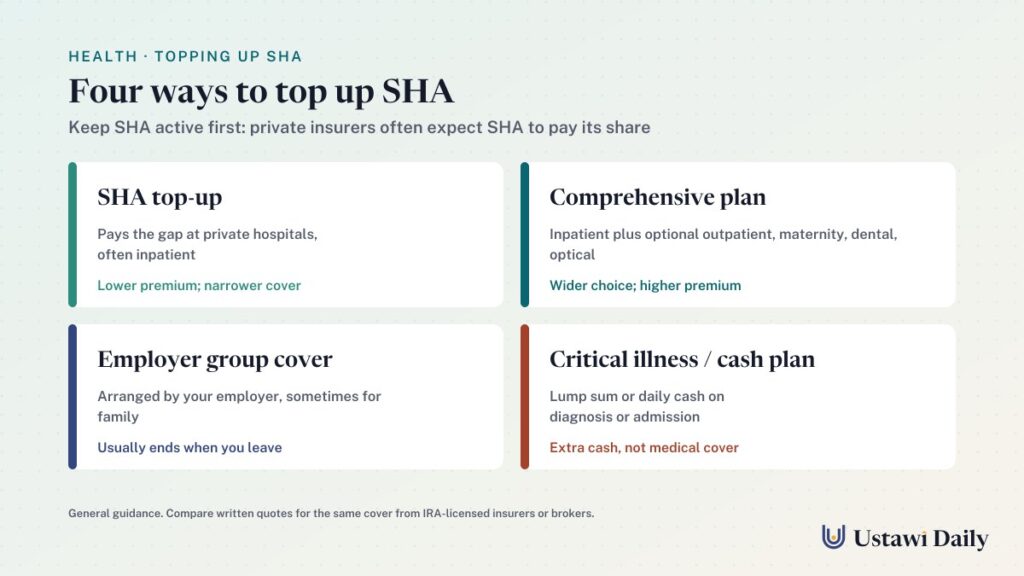
- Options range from lower-cost SHA top-up covers to comprehensive private plans, plus employer group cover and critical illness policies.
- Check the fine print: hospital network, sub-limits, waiting periods, co-payments and exclusions matter more than the headline limit.
- Tax: SHIF contributions are deductible from taxable income, and residents may claim insurance relief of 15% of qualifying health insurance premiums, up to KSh 5,000 a month.
Where SHA’s cover typically stops
SHA pays for care at facilities it has contracted. It pays set rates, called tariffs, for each service or package. Gaps tend to appear in these situations:
- Private hospitals that charge more than SHA’s tariff: you or your insurer pay the difference.
- Facilities that are not contracted by SHA, where SHA does not pay.
- Benefits SHA funds in a limited way, or not at private facilities, such as some outpatient, dental and optical care.
- High-cost, long-running treatment, such as some cancer care, where limits or package rules can leave costs to cover.
SHA’s contracts with existing healthcare providers were extended to 31 December 2026, and a new contracting cycle starts on 1 January 2027. Check whether your preferred hospitals are contracted, as this affects what SHA pays. For the basics, read SHA in Kenya explained.
How private medical insurance in Kenya works alongside SHA
Private medical insurance sits on top of SHA; it does not replace it. In practice:
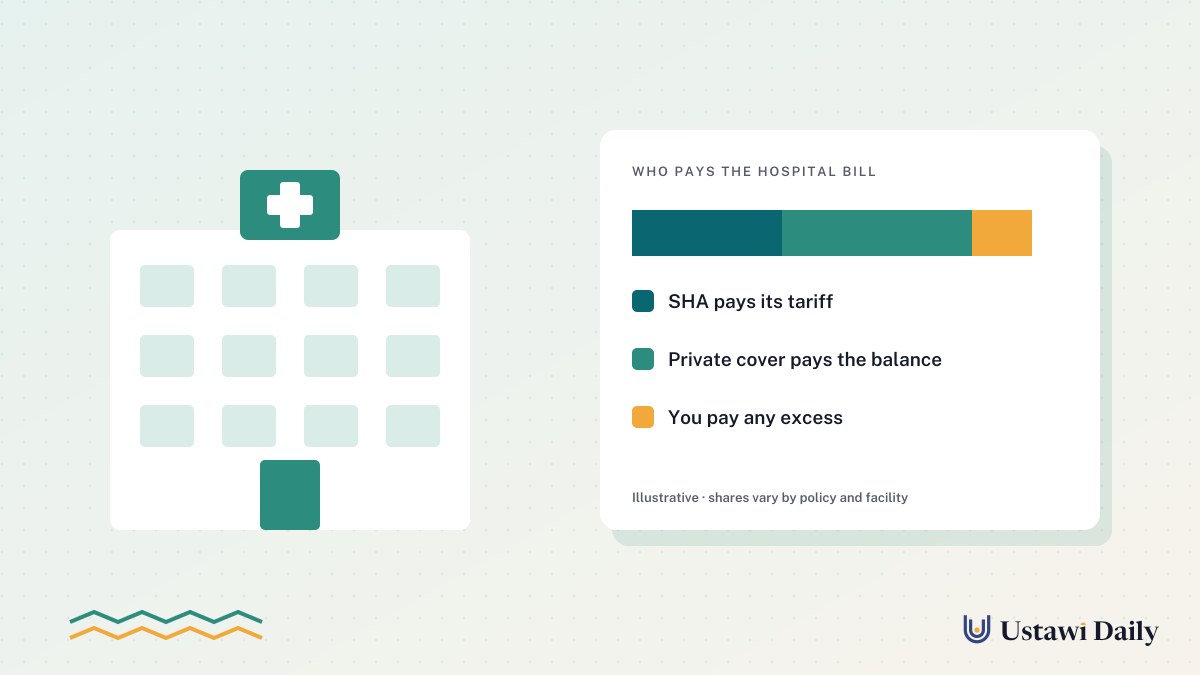
- When you are treated at a facility contracted by SHA, SHA pays its share at its tariff.
- Your private insurer then pays the balance, within your policy’s limits and terms.
- If you are not registered with SHA, or your contributions are not up to date, some insurers may reduce or refuse claims they expect SHA to share. One hospital administrator told the Daily Nation in October 2026 that insurers wait for SHA to pay first.
Ask your insurer exactly how it coordinates with SHA, and get the answer in writing or in the policy document.
Your options for topping up SHA
| Option | What it does | Best for | Watch out for |
|---|---|---|---|
| SHA top-up cover | Pays some or all of the gap between SHA’s tariff and private hospital charges, often for inpatient care | People who want private hospital access at a lower premium | Narrower benefits; usually requires active SHA cover |
| Comprehensive private cover | Inpatient cover, with options for outpatient, maternity, dental and optical | People who want wide choice and higher limits | Higher premiums; sub-limits and waiting periods |
| Employer group cover | Cover arranged by your employer, sometimes including family | Employees, where offered | Usually ends when you leave the job |
| Critical illness or hospital cash plans | Pays a lump sum or daily cash amount on diagnosis or admission | Extra cash for costs insurance does not pay | Not a substitute for medical cover |
Some people also keep an emergency fund for co-payments and excluded costs, in an easy-access money market fund.
What private medical cover costs
Premiums depend mainly on age, the limits you choose, and the benefits you add, such as outpatient, maternity, dental and optical care. The number of people covered matters too. SHA top-up covers are generally priced well below comprehensive plans, because they cover less.
Get written quotes for the same level of cover from at least three insurers or a licensed broker, so you are comparing like with like. Ask whether the premium must be paid in full upfront or can be paid in instalments.
What to check before you buy
- Hospital network: are the hospitals you would actually use included, with direct billing?
- Inpatient limit and sub-limits: look at the limits for surgery, cancer, chronic conditions and maternity, not just the headline figure.
- Waiting periods: how long before illness, maternity, chronic and pre-existing conditions are covered.
- Co-payments and excesses: what you pay yourself at each visit or claim.
- Outpatient cover: whether it is included, and its annual limit.
- SHA coordination: how the insurer works with SHA, and what happens if SHA does not pay.
- Exclusions: read the policy document, not just the brochure.
- Renewal terms: age limits, and whether the insurer can decline to renew.
- Licensing: buy only from insurers and intermediaries licensed by the Insurance Regulatory Authority (IRA).
Always declare existing conditions honestly when applying. Non-disclosure can lead to claims being rejected or the policy being cancelled.
Tax relief on SHA and private cover
- SHIF contributions are deductible from taxable employment income, under the Tax Laws (Amendment) Act, 2024, effective December 2024.
- Insurance relief: tax-resident individuals may claim relief of 15% of qualifying health insurance premiums, capped at KSh 5,000 a month (KSh 60,000 a year), shared with other qualifying insurance such as life policies.
- Who it covers: insurance relief generally applies to policies covering yourself, your spouse or your children, not parents. If you pay a parent’s premium, do not assume relief applies.
If you are employed, your employer usually applies these through PAYE once you show proof of the policy. Confirm your own position with KRA or a tax adviser.
For Kenyans abroad covering family at home
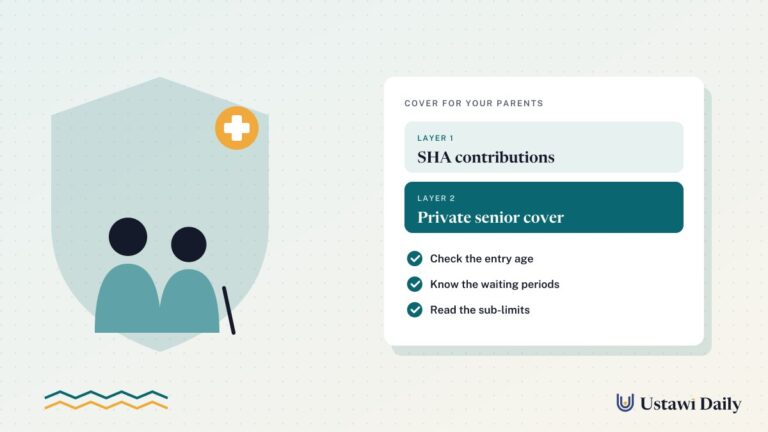
You can buy private medical cover for family in Kenya from abroad, through an insurer or licensed broker, and pay by bank transfer or other accepted methods. For older parents, entry ages and waiting periods matter especially: see our guide to health insurance for parents in Kenya.
Make sure each family member’s SHA registration and contributions are also up to date, so the private policy can work as intended.
Frequently asked questions
Do I need private medical insurance in Kenya if I have SHA?
It depends on your needs. SHA provides a foundation, but private medical insurance in Kenya can pay for private hospital charges above SHA’s rates, facilities SHA has not contracted, and benefits such as outpatient, dental and optical care.
Does private insurance pay before or after SHA?
Usually after. At facilities contracted by SHA, SHA typically pays its share first and the private insurer pays the balance within your policy limits. Ask your insurer how it coordinates with SHA.
What is a SHA top-up cover?
A private policy designed to cover some or all of the gap between what SHA pays and what a private hospital charges, usually at a lower premium than comprehensive cover.
Can I get tax relief on medical insurance in Kenya?
Tax-resident individuals may claim insurance relief of 15% of qualifying health insurance premiums, capped at KSh 5,000 a month, and SHIF contributions are deductible from taxable income.
How do I choose the best private medical insurance in Kenya?
Compare the hospital network, limits and sub-limits, waiting periods, co-payments, outpatient cover, exclusions and how the policy works with SHA, using written quotes for the same level of cover.
Read next
Have a question about medical cover? Email editor@ustawidaily.com with the subject “Question,” and we’ll answer the most common ones in future guides.
Sources: Social Health Authority notices to healthcare providers (October 2026), as reported by the Daily Nation; Kenya Revenue Authority PAYE guidance and the Tax Laws (Amendment) Act, 2024; Income Tax Act provisions on insurance relief; Insurance Regulatory Authority. Last reviewed: 28 October 2026.
This article is general information, not medical, insurance or tax advice. Policy terms vary and change. Read the full policy document and consult the insurer, a licensed broker or a tax adviser before deciding.