SHA in Kenya Explained (2026): What You Pay, What It Covers and How to Register Your Family
HEALTH · HEALTH FINANCING
SHA in Kenya replaced NHIF in October 2024, and it still confuses many households. This guide explains, in plain language, what you pay, what it covers, how to register your family, what to do if a hospital turns you away, and how to stay covered at home or abroad.
Since the Social Health Authority (SHA) took over from the National Hospital Insurance Fund (NHIF), questions have piled up. How much should I pay? Is my family covered? Why was I turned away at the hospital? How do I pay if I am self-employed, or living abroad?
This guide answers them using the rules as they stand in October 2026. Because SHA’s procedures are still evolving, we flag clearly where you should confirm details directly with SHA.
Key takeaways
- SHA replaced NHIF on 1 October 2024 under the Social Health Insurance Act, 2023. NHIF no longer exists.
- SHA runs three funds: the Primary Healthcare Fund, the Social Health Insurance Fund (SHIF) and the Emergency, Chronic and Critical Illness Fund (ECCIF).
- Contributions are 2.75% of gross monthly income, with a minimum of KSh 300 a month and no upper limit.
- Salaried workers pay through their employer. Self-employed and informal workers are assessed through means testing and pay via M-Pesa, in full or in instalments.
- Your spouse and children can be covered as dependants under your household, but they must be properly added to your SHA profile.
- Coverage depends on staying up to date. Check your status before you need care, via *147# or the SHA portal.
- Problems? Call 147 or the toll-free line 0800 720 601, or email complaints@sha.go.ke.
What is SHA in Kenya?
The Social Health Authority (SHA) is the government body that manages public health insurance in Kenya. It was created under the Social Health Insurance Act, 2023, and took over from NHIF on 1 October 2024, with NHIF’s assets, liabilities and staff transferred to the new authority.
The aim is universal health coverage: every Kenyan registered, contributing according to their income, and able to access care at contracted (“empanelled”) health facilities.
A common confusion: SHA is the authority, while SHIF is one of the funds it manages. When people say “my SHA deduction,” they usually mean their SHIF contribution.
SHA vs NHIF at a glance
| What changed | NHIF (until Sept 2024) | SHA (from Oct 2024) |
|---|---|---|
| Salaried workers | Fixed bands, up to KSh 1,700 a month | 2.75% of gross salary, minimum KSh 300, no maximum |
| Self-employed | Flat KSh 500 a month | Based on means testing, minimum KSh 300 a month |
| Structure | One fund | Three funds: Primary Healthcare, SHIF and ECCIF |
The three SHA funds and what each one covers
Instead of one pot of money like NHIF, SHA splits health cover into three funds:
- Primary Healthcare Fund: cover for primary and preventive care at Level 2 and 3 facilities (dispensaries and health centres), such as consultations, basic treatment, immunisation and family planning. Every registered member is enrolled automatically.
- Social Health Insurance Fund (SHIF): funded by members’ contributions. It covers care at Level 4 to 6 hospitals, including inpatient admission, surgery, maternity and specialist services, usually through referral from a primary facility.
- Emergency, Chronic and Critical Illness Fund (ECCIF): a safety net for emergencies, chronic conditions and critical illness, which can take over once SHIF limits are reached.
Each service comes with its own limits and tariffs, which SHA updates from time to time. For the exact cover for a specific treatment, check the current benefits package on SHA’s website or ask the facility before treatment.
How much do you pay for SHA in Kenya?
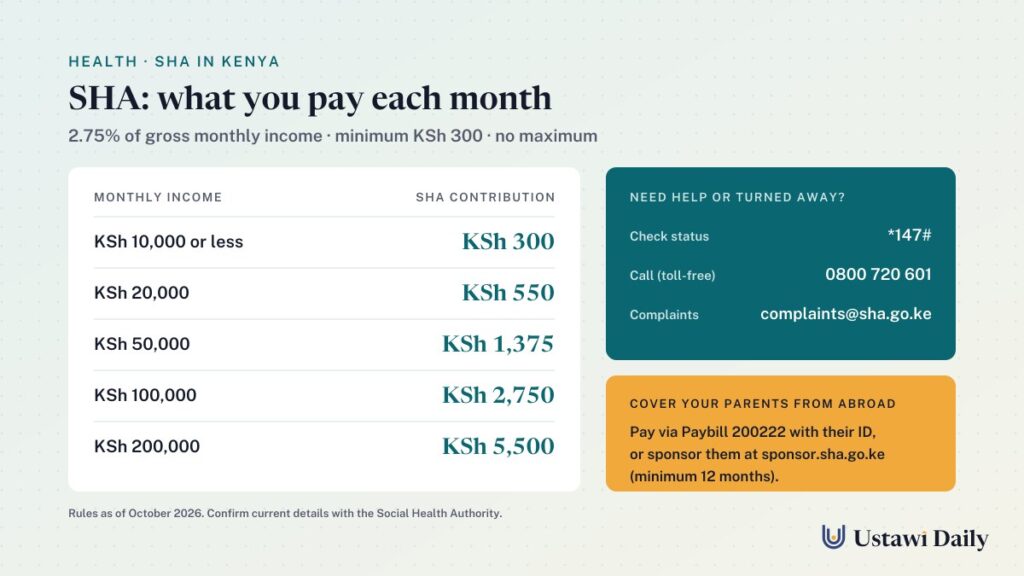
The rule is simple: 2.75% of gross monthly income, minimum KSh 300, no maximum.
| Monthly income | Monthly SHA contribution |
|---|---|
| KSh 10,000 or less | KSh 300 (the minimum) |
| KSh 20,000 | KSh 550 |
| KSh 50,000 | KSh 1,375 |
| KSh 100,000 | KSh 2,750 |
| KSh 200,000 | KSh 5,500 |
Under NHIF, contributions were capped at KSh 1,700 a month. Because SHA has no upper limit, higher earners now pay considerably more. At the other end, people earning under about KSh 6,000 a month now pay more than before (the KSh 300 minimum, compared with KSh 150 under NHIF), while some lower-middle earners pay slightly less.
If you are salaried
Your employer deducts 2.75% of your gross salary and sends it to SHA by the 9th of the following month. You don’t need to pay separately, but it’s worth checking your payslip and SHA status occasionally to confirm the money is reaching SHA.
If you are self-employed, in the informal sector or unemployed
There is no payslip, so SHA uses means testing. During registration, you answer questions about your household’s income and circumstances. SHA then assesses what you should pay, subject to the KSh 300 monthly minimum.
You pay through M-Pesa Paybill 200222, using your National ID number as the account number. Anyone, such as a relative, can pay on your behalf, as long as they use your ID number.
You can pay the full year at once or use Lipa SHA Pole Pole, which lets you pay in instalments. Under SHA’s published terms, you pay four months’ contributions upfront and the rest in instalments, with no interest. In August 2026, SHA also warned that late payments by informal-sector households attract a 2% penalty.
How to register for SHA in Kenya
Registration is free. Never pay anyone who offers to “fast-track” your registration; SHA does not charge for it.
By phone (no internet needed):
- Dial *147#.
- Choose the SHA registration option and enter your National ID number.
- Confirm your details, then select your county, employment status and marital status.
- Add your dependants and, if you are not salaried, complete the means-testing questions.
- Review and submit. You will receive confirmation, and your assessed contribution if you are not salaried.
Online: register through the official SHA website, or use the SHA mobile app.
In person: visit a Huduma Centre or SHA office, or ask a community health promoter for help.
Adding your spouse and children
SHA covers a household, but only if your dependants are added to your profile. Don’t assume your family details carried over from NHIF: check your profile now rather than at the hospital.
- Who qualifies: mainly your spouse and children. Rules for older children are stricter. Guides commonly say children over 21 need proof of full-time education. Those over 25 generally qualify only if they have a disability and depend on you. Confirm the current rules with SHA.
- Your spouse usually needs to have their own SHA registration before being linked, and you may need proof of marriage.
- Children are added with their birth certificate numbers.
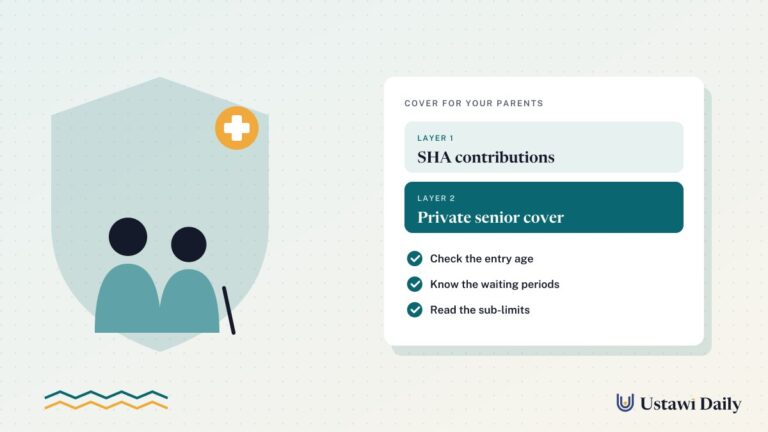
- Parents are generally not dependants under SHA. They need their own registration and contributions, but you can pay for them (see “Covering your parents” below).
You can add or update dependants through *147#, the SHA portal or the app.
How to check that you are covered
Before you need treatment, confirm your status:
- Dial *147# and choose the option to check your status, or
- Log in to the SHA member portal.
At the hospital, you identify yourself with your National ID. If your status shows inactive because of missed payments, clearing the arrears restores access, but it may take time to reflect. SHA does not publish one single waiting period for all cases, so don’t wait for an emergency to check.
SHA for Kenyans living abroad
SHA contributions are compulsory for Kenyan residents. Kenyans living abroad are generally not required to contribute, but many choose to register and pay voluntarily, for three good reasons:
- to keep cover active for a spouse or children living in Kenya
- to be covered during visits home
- to keep their record continuous if they plan to return
Practical tips: payments go through M-Pesa Paybill 200222 with the member’s ID number, so a relative in Kenya can pay for you, or you can pay through a remittance service that sends to M-Pesa. Keep your Kenyan phone number active, because SHA uses it for verification codes. Prepaying a full year is the simplest way to avoid missed months.
Covering your parents from abroad
Many Kenyans abroad want to make sure their parents are covered. Because parents are not dependants under SHA, they need their own registration and contributions. You have two official ways to pay for them:
- Pay their contributions directly through M-Pesa Paybill 200222, using their National ID number as the account number.
- Use SHA’s sponsorship programme, Bima Bora, Afya Nyumbani, opened to individuals and organisations in October 2026. Sponsors register at sponsor.sha.go.ke and must cover each beneficiary for at least 12 months. Your parents must have completed SHA registration and means testing first, or they may be left off the payment list.
Either way, check that your parents’ registration, means testing and phone details are complete, and confirm their status on *147# after you pay.
Turned away at the hospital? What to do
Most SHA problems at the hospital have a few common causes. Here is how to handle them.
- Check your phone line is registered in your own name. SHA verifies members through their ID and phone number. The Ministry of Health has said that about 2,000 of the roughly 6,000 people who call SHA’s call centre each day are denied services because their ID and phone registration don’t match, often because the SIM card is registered under a parent’s or relative’s ID. Fix this at your mobile provider’s shop before you need care.
- The system is down? You should still be treated. In March 2026, the Health Cabinet Secretary directed all SHA-contracted facilities to keep serving patients during technical failures, and warned that facilities turning patients away without a valid reason would face action.
- Call SHA. Use the short code 147 or the toll-free line 0800 720 601, which the Ministry describes as a 24-hour line.
- Complain in writing. Email complaints@sha.go.ke for service problems, or fraud@sha.go.ke to report fraud, such as being charged for services SHA has paid for.
- Keep records: the facility name, date, time, names of staff you spoke to, and any receipts.
The challenges: what to know before you rely on SHA in Kenya
SHA has registered more than 32 million Kenyans, but in August 2026 Parliament’s Health Committee said only about 5 million were actively contributing. The system has faced real problems, and honest planning means knowing them:
- Coverage gaps: many members have complained that cover for some chronic conditions, specialised treatment and outpatient services is limited, leaving them to pay part of the bill themselves.
- Not every facility is contracted: only empanelled facilities accept SHA, so confirm before treatment.
- Registration and dependant errors: members have reported missing dependants and records that did not carry over from NHIF.
- Scams and fraud: fake agents and fake registration links have targeted members, so use only official channels. SHA has also acted against fraudulent claims by some facilities, and dozens of private facilities were closed in early 2026 after audits.
For many households, SHA works best as a foundation, combined with personal savings for health emergencies and, where affordable, private insurance for wider cover.
Frequently asked questions
How much does SHA in Kenya cost per month?
2.75% of your gross monthly income, with a minimum of KSh 300 and no maximum. Someone earning KSh 50,000 a month pays KSh 1,375.
What is the difference between SHA and SHIF?
SHA is the authority that manages public health insurance. SHIF is one of its three funds, the one your contributions go into. The other two are the Primary Healthcare Fund and the Emergency, Chronic and Critical Illness Fund.
How do I register for SHA?
Dial *147#, use the official SHA website or app, or visit a Huduma Centre or SHA office. Registration is free.
Can I pay SHA in instalments?
Yes. Self-employed and informal-sector members can use Lipa SHA Pole Pole, paying four months upfront and the rest in instalments with no interest.
Does SHA cover my family?
Yes, your spouse and children can be covered as dependants, but they must be added to your SHA profile. Parents generally need their own registration.
What should I do if a hospital turns me away over SHA?
Confirm your status via *147#, and check that your phone line is registered under your own ID. If the problem is a system failure, contracted facilities have been directed to keep treating patients. Call 147 or 0800 720 601, and email complaints@sha.go.ke with the details.
Do Kenyans abroad have to pay SHA?
Kenyans living abroad are generally not required to contribute, but they can register and pay voluntarily, which is useful for keeping family in Kenya covered.
Can I pay SHA for my parents?
Yes. Pay their contributions through M-Pesa Paybill 200222 using their ID number, or sponsor them for at least 12 months through SHA’s sponsorship programme at sponsor.sha.go.ke. They must be registered and means-tested first.
Read next
- Sending money to Kenya: how to cut remittance costs
- Money market funds in Kenya explained: how they work and how to choose one
- More from our Health section
- Health insurance for parents in Kenya
Have a question about SHA? Send it to editor@ustawidaily.com with the subject “Question,” and we’ll answer the most common ones in future guides.
Sources: Social Health Authority; Social Health Insurance Act, 2023; SHA public notices, including on late-payment penalties (August 2026) and the sponsorship programme (October 2026); National Assembly Health Committee (August 2026). Last reviewed: 20 October 2026.
This article is general information, not medical or legal advice. SHA rules, benefits and procedures change. Confirm current details with the Social Health Authority or your health facility before treatment.