Is Dairy Farming in Kenya Profitable? A Realistic Look at Costs and Returns per Cow (2026)
AGRIBUSINESS · LIVESTOCK & DAIRY
Is dairy farming in Kenya profitable? Yes, but margins are often thin and prices swing with the seasons, so most of the profit is won or lost on two things: how much milk each cow gives and how much you spend on feed. Here is a realistic look at costs, prices and returns per cow, based on the Kenya Dairy Board’s own studies.
Dairy farming is one of the most popular investments in Kenya, for farmers at home and for Kenyans abroad planning a farm back home. It promises daily income, steady demand and a business you can grow one cow at a time.
But many new dairy farmers are disappointed. They buy cows, start selling milk, and discover that feed bills swallow most of the income. This guide uses official cost-of-production studies and current market prices to show what the numbers really look like, and what separates profitable dairy farms from struggling ones.
Key takeaways
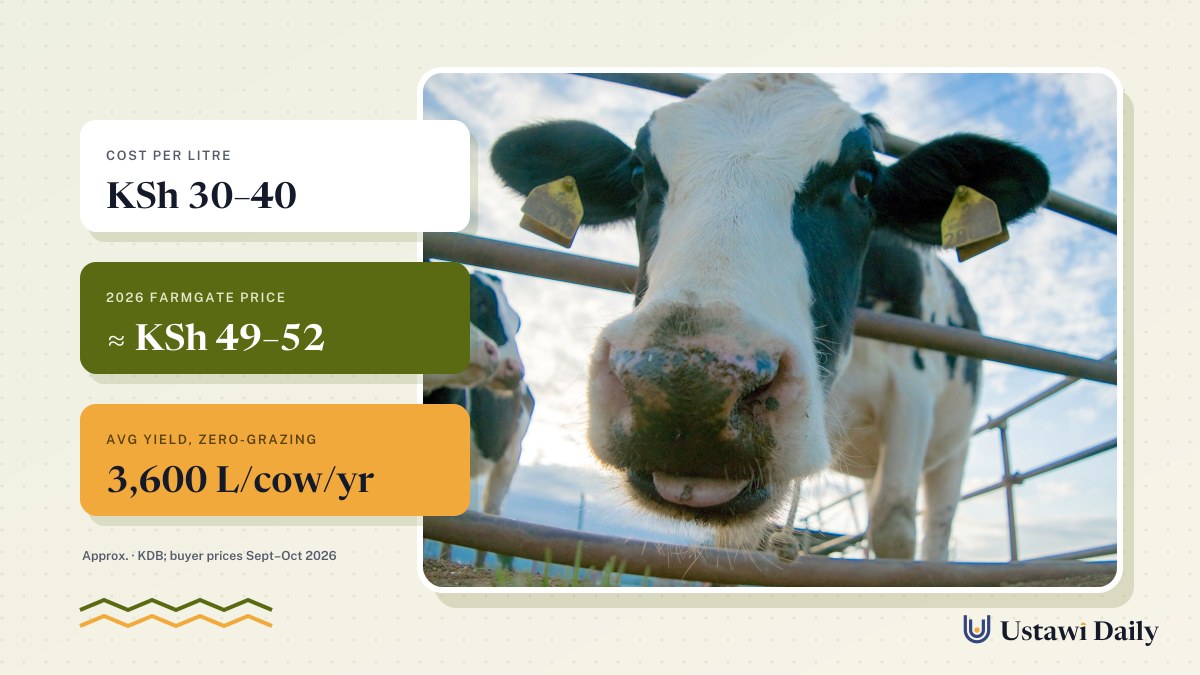
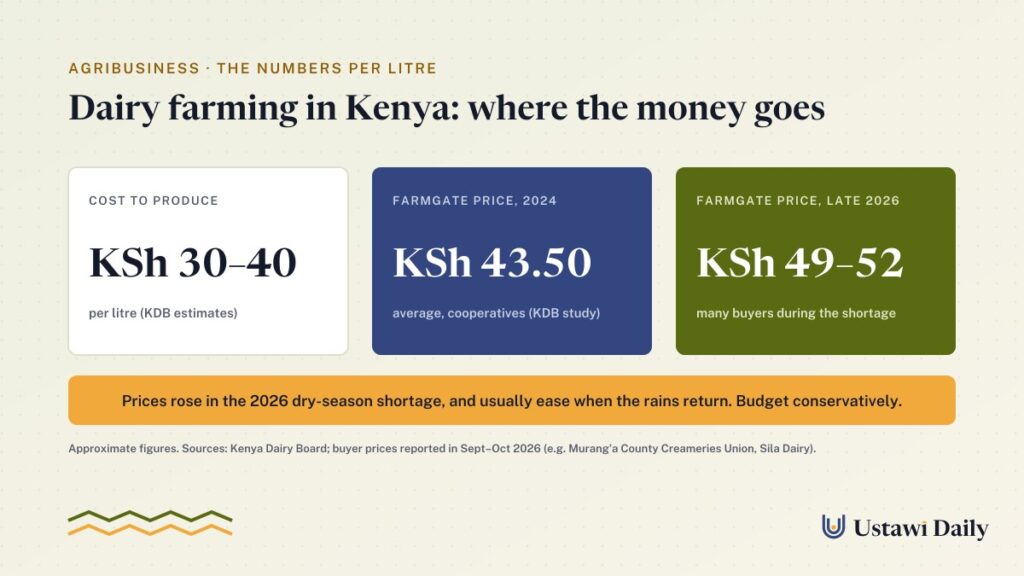
- The Kenya Dairy Board’s latest figures put the cost of producing a litre of milk at roughly KSh 30 to 40, depending on the farming system and scale. Zero-grazing is usually the most expensive per litre.
- Farmgate prices through cooperatives averaged about KSh 43.50 a litre in the Board’s 2024 study. During the 2026 dry-season shortage, many buyers raised prices to around KSh 49 to 52, and some paid KSh 55 to 60.
- At 2024 prices, the average margin was only about KSh 10 a litre. Higher 2026 prices have widened margins for many farmers, but feed costs have risen too, and prices usually ease when the rains return. Budget with conservative prices.
- Milk yield per cow is the biggest profit lever. The Board’s 2024 study found zero-grazing cows averaged about 3,600 litres a year, well below what well-managed cows can achieve.
- Feed is the largest cost, especially concentrates such as dairy meal. Growing your own fodder is the most reliable way to protect margins.
- Dairy can be profitable from abroad, but only with a trusted manager, good records and regular checks.
The short answer: is dairy farming in Kenya profitable?
Yes, on average. The Kenya Dairy Board (KDB), the sector regulator, publishes an annual study on the cost of milk production. Its 2024 study found that dairy farming still makes money on average, but feed and other costs eat up most of what farmers earn.
In other words, dairy farming in Kenya is a volume and efficiency business. A farm that gets high yields from each cow and controls its feed costs can do well. A farm with low-yielding cows and expensive bought-in feed can lose money on every litre.
What it costs to produce a litre of milk in Kenya
The cost of production includes everything it takes to produce milk: feed, labour, veterinary care, breeding (artificial insemination), water, electricity, equipment and the cost of the animals themselves.
In May 2026, the Kenya Dairy Board put the cost of producing a litre of milk at between KSh 30 and KSh 37, depending on the farming system and scale of production. Figures from a KDB study cited to the Senate by Cabinet Secretary Mutahi Kagwe show how costs differ by system:
| Farming system | How it works | Approximate cost per litre |
|---|---|---|
| Zero-grazing | Cows kept in a shed and fed cut fodder and concentrates | About KSh 39.50 |
| Semi-zero grazing | Cows graze part of the day and are stall-fed the rest | About KSh 37.30 |
| Open grazing | Cows graze on pasture most of the time | About KSh 24.50 |
The same figures put average profit at about KSh 9.90 per litre. Estimates differ slightly between studies and over time, but they consistently show that zero-grazing costs the most per litre.
Two things stand out:
- Zero-grazing costs the most per litre, mainly because of bought-in concentrates and cut fodder. It also produces the most milk per cow, which is why it remains popular where land is limited.
- Open grazing is cheapest per litre but needs much more land, and yields per cow are usually lower.
This pattern is long-standing. A 2019 study commissioned by the Board found that profit per litre was highest for semi-zero grazers and lowest for zero grazers. Semi-zero grazing often offers the best balance where land allows.
What farmers are paid for milk
The price you receive depends on who buys your milk, the season and your location.
- Cooperatives and processors: the Kenya Dairy Board’s 2024 study found cooperative prices ranged from about KSh 37 to 48 a litre, averaging KSh 43.50. Prices have since risen (see the 2026 update below).
- Seasonal swings: prices typically fall in the rainy “flush” season, when milk is plentiful, and rise in dry seasons, when it is scarce. Plan your cash flow for the low months.
- Selling directly: selling to households, hotels or institutions can pay more (one farmer quoted by the Kenya News Agency in October 2026 cited about KSh 70 a litre in direct sales, against about KSh 50 from a factory), but milk sales are regulated. In 2026 the government stepped up enforcement against unlicensed raw milk trade. Make sure you sell through licensed channels and meet Kenya Dairy Board requirements.
2026 update: the milk shortage and higher prices
Milk prices rose sharply in mid-to-late 2026 as a long dry season cut pasture and production. According to Kenya Dairy Board data, milk delivered to processors fell from 84.4 million litres in June to 81.3 million in July and about 75 million in August.
- Buyers raised prices to compete for milk. Murang’a County Creameries Union increased its farmgate price from KSh 42 a litre in June to KSh 49 in September, and Sila Dairy from KSh 42 to KSh 50. Agriculture Cabinet Secretary Mutahi Kagwe told the Senate that some companies were paying KSh 55 to 60.
- The government’s minimum return rose. In October 2026, Deputy President Kithure Kindiki said the guaranteed minimum return for milk had increased from KSh 37 to KSh 50 a litre.
- Feed costs rose too. Farmers and traders in the North Rift reported feed prices up by about a third, which eats into the gains from higher milk prices.
- Prices may ease. The Kenya Dairy Board and the Ministry expect the October to December rains to restore pasture and milk supply, which usually brings farmgate prices down.
What it means for you: higher prices have improved returns for farmers with milk to sell, especially those who conserved feed. But do not plan a new dairy around shortage prices. Use a conservative price in your budget, and treat anything above it as a bonus.
The numbers per cow: a worked example
To show how yield and price drive profit, here is a simple illustration using the Kenya Dairy Board’s figures. It assumes a total cost of KSh 37 per litre and shows the annual profit per cow at different yields and milk prices. KSh 45 is a conservative, rainy-season price; KSh 50 to 60 reflects late-2026 shortage prices.
| Milk per cow per year | At KSh 45 a litre | At KSh 50 a litre | At KSh 55 a litre | At KSh 60 a litre |
|---|---|---|---|---|
| 3,600 litres (KDB zero-grazing average) | KSh 28,800 | KSh 46,800 | KSh 64,800 | KSh 82,800 |
| 4,500 litres | KSh 36,000 | KSh 58,500 | KSh 81,000 | KSh 103,500 |
| 5,400 litres | KSh 43,200 | KSh 70,200 | KSh 97,200 | KSh 124,200 |
Illustrative only. In practice, the cost per litre generally falls as yield rises, because fixed costs such as labour and housing are spread over more milk, so well-run high-yield farms can do better than this table suggests. Your actual figures will depend on your farm.
What the table tells you: at a conservative price and an average yield, a cow earns only a modest profit. Raise the yield and the price together, and the same cow can earn several times more. That is why the best dairy farmers obsess over feeding, breeding and selling well.
Why yield per cow is the biggest profit lever
The Kenya Dairy Board’s 2024 study found that zero-grazing cows produced about 3,600 litres a year, which the Board noted is still well below what is needed to compete with leading dairy nations. Well-fed, well-bred cows can produce considerably more.
Higher yields come from:
- Good genetics: buying quality animals and using proven artificial insemination (AI) bulls.
- Balanced feeding: enough quality roughage (Napier, silage, hay) plus the right amount of concentrate for each cow’s production level.
- Clean water at all times: a milking cow drinks a great deal, and shortages cut yields quickly.
- Fertility management: getting cows back in calf on time. Long gaps between calvings mean long periods with no milk.
- Health: preventing mastitis, tick-borne diseases and other illnesses through hygiene, vaccination and prompt veterinary care.
Feed: the cost that makes or breaks a dairy farm
Every study points to the same culprit: feed, especially concentrates, is the biggest cost in Kenyan dairy farming, and the main reason margins are thin. Three practical ways to control it:
- Grow your own fodder. Napier grass, Boma Rhodes hay, fodder maize for silage and legumes such as desmodium cut reliance on expensive bought-in feed. The government has also been leasing public land for fodder production to help farmers.
- Conserve feed for the dry season. Silage and hay made during the rains protect both yields and margins when feed prices rise.
- Feed concentrates by production, not habit. Giving every cow the same amount of dairy meal wastes money on low producers. Match concentrates to each cow’s milk yield, with advice from a livestock extension officer or nutritionist.
Startup costs to plan for
Costs vary widely by location and scale, so get local quotes before you invest. Plan for:
- The cows: quality in-calf heifers or milking cows are the biggest single purchase. Prices vary with breed, age and yield record.
- Housing: a zero-grazing unit with feeding troughs, a water point, a resting area and drainage.
- Equipment: a chaff cutter, milking equipment, milk cans and a water tank.
- Fodder land and planting: Napier or other fodder established before the cows arrive.
- Running costs for the first months: feed, labour, veterinary care and AI before milk income stabilises.
A sensible approach is to start small, with two to five good cows, learn the system, keep detailed records and expand only when your figures show a consistent profit.
The biggest risks
- Feed price spikes, especially in droughts.
- Milk price swings between the flush and dry seasons.
- Disease, which can cut yields or kill animals.
- Poor breeding records, leading to low-quality calves and long calving intervals.
- Unreliable labour or management, which is the most common problem for absentee owners.
- Market access: delayed payments or limited buyers in some areas.
Running a dairy farm from abroad
Many Kenyans in the diaspora invest in dairy back home. It can work, but distance multiplies every risk above. Before you start:
- Secure the land properly first. If you are buying land for the farm, follow our guide on how to verify a title deed in Kenya from abroad.
- Hire a trusted, experienced farm manager, ideally with references from other farm owners, and agree clear duties and pay.
- Insist on records: daily milk yields per cow, feed used, milk sold, payments received and veterinary treatments.
- Have milk payments made directly to you, for example from the cooperative to your own account, rather than in cash through the manager.
- Arrange independent checks through visits by a trusted relative or a livestock extension officer.
7 ways to make dairy farming in Kenya more profitable
- Measure everything: know your cost per litre and yield per cow.
- Invest in genetics: fewer good cows beat many poor ones.
- Grow and conserve your own fodder to cut feed costs.
- Feed concentrates by yield, not equally to every cow.
- Keep cows calving regularly with good fertility management.
- Join a well-run cooperative for reliable sales, inputs and services.
- Sell bull calves and manure: extra income streams that improve overall returns.
Frequently asked questions
Is dairy farming in Kenya profitable?
Yes, on average, according to the Kenya Dairy Board’s studies, but margins are often thin because feed costs are high, and prices swing with the seasons. Profit depends mainly on milk yield per cow, feed costs and the price you receive.
How much does it cost to produce a litre of milk in Kenya?
The Kenya Dairy Board’s recent figures put it at roughly KSh 30 to 40 per litre, depending on the farming system and scale. Zero-grazing is usually the most expensive per litre.
How much profit does a dairy cow make in Kenya?
It varies widely. Using the Board’s average cost and a 3,600-litre yield, a cow might earn roughly KSh 29,000 to 83,000 a year at milk prices of KSh 45 to 60 a litre, and more with higher yields.
How many litres of milk does a cow produce in Kenya?
The Kenya Dairy Board’s 2024 study found zero-grazing cows averaged about 3,600 litres a year. Well-fed, well-bred cows can produce considerably more.
What is the price of milk per litre for farmers in Kenya in 2026?
It varies by buyer and season. During the 2026 shortage, many cooperatives and processors paid around KSh 49 to 52 a litre, and some paid KSh 55 to 60. Prices usually ease when the rains improve supply.
Which is better: zero-grazing or semi-zero grazing?
Zero-grazing suits small land sizes and gives high yields per cow, but costs more per litre. Where land allows, semi-zero grazing has historically returned the highest profit per litre.
Can I run a dairy farm in Kenya while living abroad?
Yes, with a trusted manager, detailed records, direct milk payments to your own account and regular independent checks.
Read next
- How to verify a title deed in Kenya from abroad: a step-by-step guide
- Money market funds in Kenya explained: how they work and how to choose one
- More from our Agribusiness section
- Silage making in Kenya: how to cut dairy feed costs
- Agribusiness in Kenya from abroad
Farming or planning to farm? Send your questions to editor@ustawidaily.com with the subject “Question,” and we’ll answer the most common ones in future guides.
Sources: Kenya Dairy Board cost of milk production studies, including the 2024 Study Report on Milk Production Costs and Profitability and the 2019 study undertaken with Tegemeo Institute; statements by the Ministry of Agriculture and Livestock Development and to the Senate; Kenya Dairy Board milk intake data; Business Today (October 2026) and the Kenya News Agency on 2026 farmgate prices. Last reviewed: 20 October 2026.
This article is general information, not financial or veterinary advice. Costs, yields and milk prices vary by location, season and management. Get local advice from a livestock extension officer or qualified professional before investing.