Agribusiness in Kenya From Abroad (2026): What Works, What Fails and How to Protect Your Money

AGRIBUSINESS · DIASPORA DESK
Farming is Kenya’s largest economic sector, and many Kenyans abroad dream of owning a farm back home. Some build profitable businesses; others lose money to poor management, weather and schemes that sound too good to be true. Here is an honest guide to investing in agribusiness in Kenya from abroad: what works, what fails, and how to protect your money from a distance.
Agriculture, forestry and fishing accounted for 23.2% of Kenya’s GDP in 2025, worth about KSh 4.07 trillion, according to the Kenya National Bureau of Statistics’ Economic Survey 2026. That makes it the country’s largest single sector. Horticulture alone earned about KSh 216.5 billion in exports.
Those numbers attract investors, including Kenyans abroad. But the same survey shows the risks too: the sector grew only about 3.1% in 2025, slowed by erratic rainfall. Agribusiness in Kenya can be rewarding, but it is a business, not a savings account, and it rewards careful planning far more than enthusiasm.
Key takeaways
- There are two broad ways in: running a farm or agribusiness yourself, through a manager, or investing more passively, for example in listed agricultural companies or by leasing land to farmers.
- Common causes of failure for absentee investors include weak management and controls, no secure market, weather and disease, and running out of working capital.
- Find the buyer before you plant. Know who will buy your produce, at roughly what price, before you invest.
- Start small, prove the numbers, then scale. Track the cost and income per unit: per litre, per kilo, per bird.
- Be very wary of schemes promising fixed high returns from farming. Agricultural returns are never guaranteed.
Two ways to invest in agribusiness in Kenya
| Approach | Examples | Your involvement | Main risks |
|---|---|---|---|
| Active: run an enterprise | Dairy, poultry, fish farming, horticulture, fruit orchards, greenhouses | High: you hire and supervise a manager, and make key decisions | Management, theft, weather, disease, market prices |
| Active: value-chain business | Produce aggregation, cold storage, processing, input supply, machinery hire | High: closer to running a business than a farm | Capital needs, management, competition |
| Passive: listed companies | Agricultural shares on the Nairobi Securities Exchange, such as tea and fruit producers | Low | Share prices, commodity prices, weather |
| Passive: lease your land | Leasing farmland to an established farmer for rent | Low to moderate | Tenant default, land misuse, disputes |
For passive exposure, agricultural companies listed on the NSE include Kakuzi, Sasini and several tea producers. See how to buy shares on the NSE from abroad. This is not a recommendation of any company; research each one first.
Match the enterprise to your situation
Enterprises differ a great deal in how quickly they earn and how closely they must be managed. This general comparison can help you shortlist:
| Enterprise | Time to first income | Day-to-day management | Key risks |
|---|---|---|---|
| Broiler chickens | Weeks | Very high | Disease, feed prices, market timing |
| Layer chickens | Months | Very high | Disease, feed prices, egg prices |
| Dairy | Weeks to months, depending on whether cows are already milking | Very high | Feed costs, animal health, milk prices |
| Greenhouse vegetables | Months | High | Pests, water, prices, quality standards |
| Fish farming | Months | High | Water quality, feed, theft, market access |
| Fruit or nut orchards (such as avocado or macadamia) | Several years | Moderate | Long wait for income, export standards, prices |
| Leasing land to a farmer | From the start of the lease | Low | Tenant default, misuse of land |
A general guide only: actual timelines and risks depend on scale, location, water and management.
As a rule, the faster an enterprise turns over, the more hands-on management it needs, which is a challenge from abroad. Longer-term enterprises such as orchards need less daily work, but you must fund them for years before income arrives.
What works: the habits of successful absentee agribusiness owners
- They secure a market first. Before planting or buying stock, they know who will buy the produce: a cooperative, processor, exporter, supermarket or institution. Some use contract farming, agreeing price and quality terms with a buyer in advance.
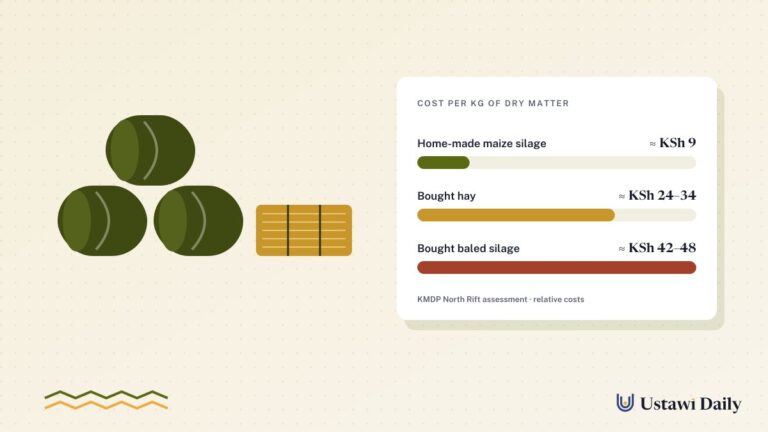
- They know their unit economics. They track the full cost of producing one unit, such as a litre of milk or a kilo of fish, against the price they receive. Our analysis of dairy farming profitability shows why this matters: in dairy, the margin per litre can be thin.
- They start small and scale. A pilot season or a few animals reveals the real costs, risks and management quality before larger sums are at stake.
- They hire, train and incentivise a capable manager. Good managers are paid fairly, and some earn a share of results.
- They build strong controls. Sales are paid directly into the owner’s account or till, not to the manager in cash. Records are kept every day, and reports are reviewed every month.
- They manage risk. They use water storage or irrigation where possible, certified seed and breeds, veterinary and agronomy support, and insurance where available.
- They meet quality standards. In export crops, buyers reject produce that breaks rules on pesticide residues. The Economic Survey 2026 reports that earnings from fresh vegetable exports fell about 9% in 2025, largely due to such violations and export interceptions.
What fails: common mistakes in agribusiness in Kenya
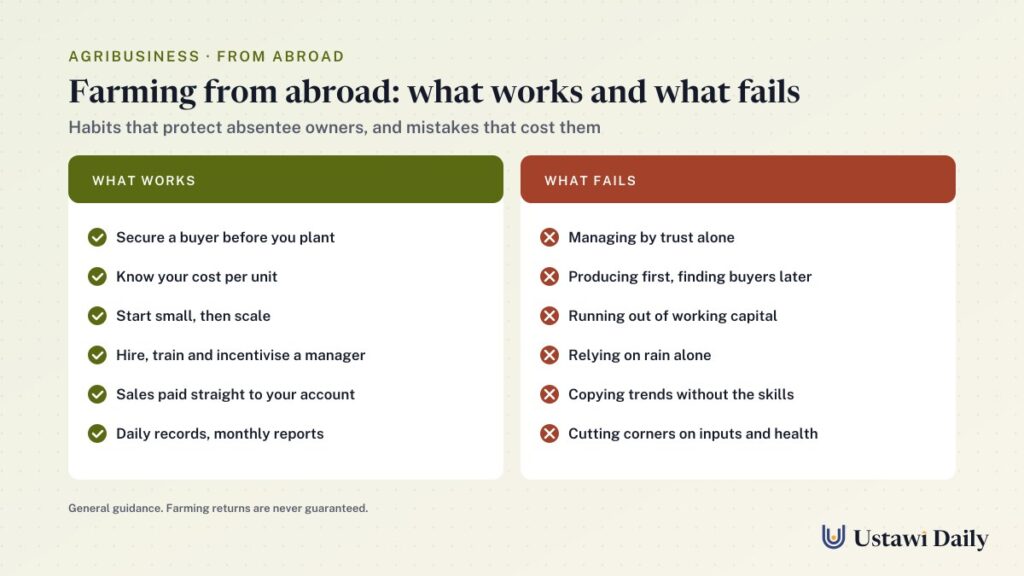
- Remote management by trust alone. Sending money to a relative or worker without clear budgets, records or checks can quickly lead to losses.
- Producing first, looking for buyers later. Perishable produce with no buyer quickly becomes a loss.
- Underestimating working capital. Feed, labour, inputs and transport must be paid for months before income arrives.
- Relying on rain alone. 2025 showed how erratic rainfall can cut output. Water planning is essential for most enterprises.
- Copying a trend without the skills. Popular enterprises can become crowded, prices can fall, and success depends heavily on technical know-how.
- Cutting corners on inputs and animal health. Cheap seed, poor feed or skipped vaccinations often cost far more later.
Beware of “guaranteed” farming returns
Some schemes invite investors to fund trees, greenhouses or livestock in exchange for fixed, high returns, often with little paperwork. Farming income depends on weather, disease and prices, so no genuine farming investment can guarantee a fixed high return.
Before investing in any scheme run by someone else:
- Ask exactly what you will own, and get it in a written agreement reviewed by your own advocate.
- If the scheme pools money from many investors, check whether it is approved by the Capital Markets Authority, which regulates collective investment schemes.
- Visit the farm, or send someone independent, and speak to existing investors.
- Treat pressure to “invest now” and promises of returns far above Treasury bills as red flags.
How to set up and control a farm from abroad
- Secure the land legally, owned or leased, with a written agreement. See how to verify a title deed in Kenya and the real cost of buying land in Kenya.
- Write a simple business plan: the enterprise, the market, start-up costs, monthly running costs, expected income, and a cash buffer.
- Hire the right people: a manager with relevant experience, and access to a vet or agronomist.
- Separate the money: a dedicated Kenyan bank account for the farm, with income paid in directly. See how to open a bank account in Kenya from abroad.
- Agree reporting: daily records of production and sales, monthly accounts, and regular photos and videos.
- Arrange independent checks: occasional visits by a trusted person or professional who is not the manager.
- Review and adjust each season, before investing more.
Is agribusiness right for you?
Agribusiness suits investors who can tolerate risk, commit time to oversight, and wait for returns. If you want steady, low-effort income, options such as Treasury bills or a money market fund may suit you better, and some investors combine both. See how to invest in Kenya from abroad for the full range of options.
Frequently asked questions
What is the most profitable agribusiness in Kenya?
There is no single answer. Profit depends on your market, management, location, water and costs. Enterprises that do well tend to have a secure buyer, good management and tight cost control. Start small and test the numbers before scaling.
Can I run a farm in Kenya while living abroad?
Yes, but it requires a capable manager, strong financial controls, regular reporting and independent checks. Without these, absentee farming carries high risk.
How much do I need to start an agribusiness in Kenya?
It varies widely by enterprise and scale. Budget for start-up costs, several months of running costs before income arrives, and a cash buffer for emergencies.
Are farm investment schemes with guaranteed returns safe?
Be very cautious. Farming returns cannot be guaranteed. Check what you will own, whether a pooled scheme is approved by the Capital Markets Authority, and visit the farm before investing.
How can I invest in agriculture without farming?
You can buy shares in agricultural companies listed on the Nairobi Securities Exchange, or lease your land to an established farmer.
Read next
- Is dairy farming in Kenya profitable?
- How to invest in Kenya from abroad: the complete guide
- How to buy shares on the NSE from abroad
Running or planning a farm from abroad? Email editor@ustawidaily.com with the subject “Question,” and we’ll answer the most common ones in future guides.
Sources: Kenya National Bureau of Statistics, Economic Survey 2026; Capital Markets Authority; Nairobi Securities Exchange. Last reviewed: 28 October 2026.
This article is general information, not financial or agricultural advice. Agribusiness carries risk, and returns are never guaranteed. Seek professional advice before investing.