How to Open a Bank Account in Kenya From Abroad (2026): Documents, Steps and Mistakes to Avoid
DIASPORA DESK · FINANCE
A Kenyan bank account is the foundation of almost everything you want to do back home: buying land safely, investing in Treasury bills, supporting family and receiving rent. Here is how to open a bank account in Kenya from abroad, step by step, which documents you need, and how to keep the account safe and active.
Many Kenyans abroad put off opening a local bank account because they assume it means flying home and queuing at a branch. It usually doesn’t. Most major Kenyan banks now run dedicated diaspora services that let you apply online or by post, with your documents certified in the country where you live.
This guide explains how to open a bank account in Kenya from abroad and what each document is for. It also shows how to choose between banks, and the mistakes that cost diaspora account holders money every year.
Key takeaways
- You can usually open a Kenyan bank account without travelling home. Many banks accept online applications with documents certified abroad.
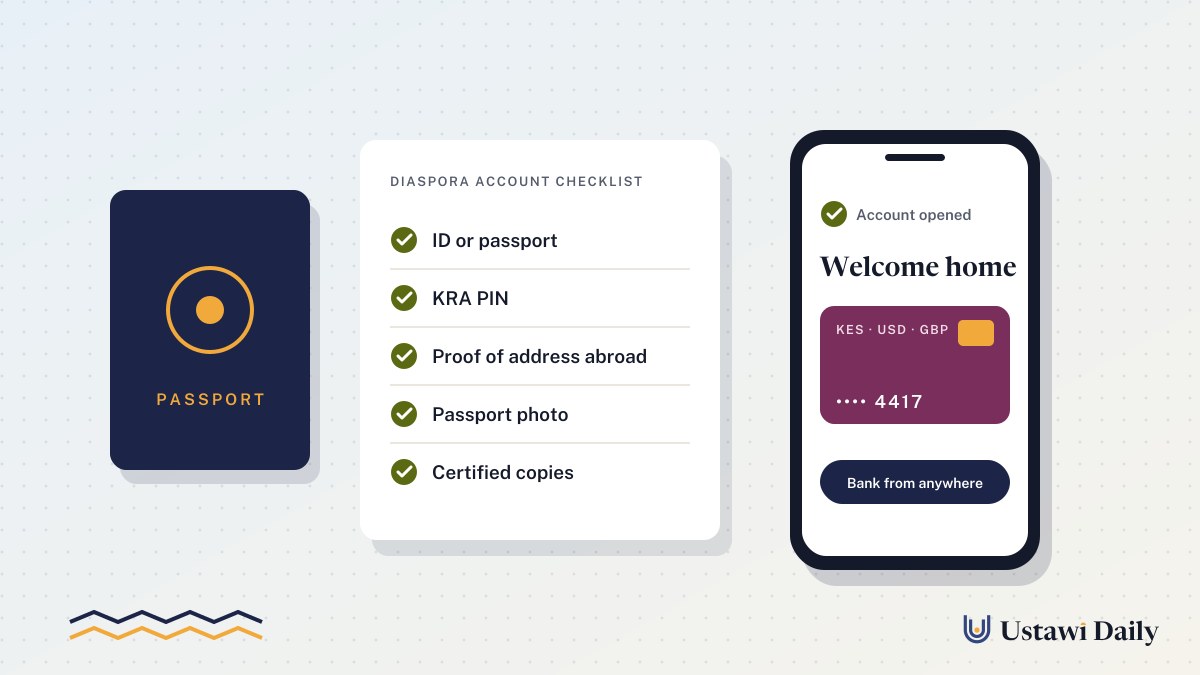
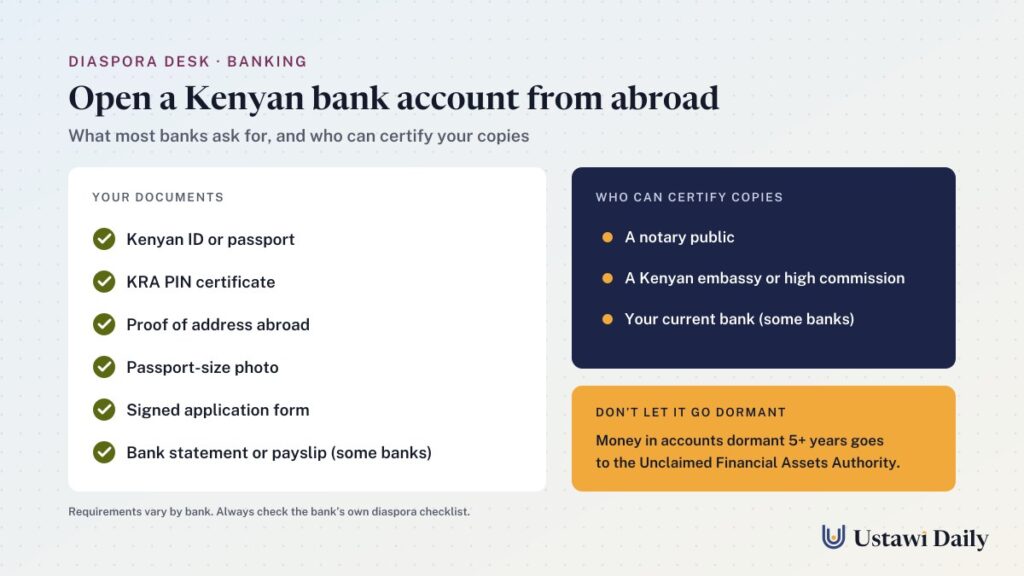
- Expect to need a Kenyan ID or passport, a KRA PIN, proof of your address abroad and a passport photo. Some banks also ask for a recent bank statement or payslip.
- Documents are typically certified by a notary public, a Kenyan embassy or high commission, or sometimes your current bank.
- Diaspora accounts often come in shillings, US dollars, pounds or euros. Foreign-currency accounts may require proof that you earn in that currency.
- US citizens and green card holders should expect extra US tax forms under FATCA.
- Keep the account active. Bank accounts dormant for more than five years are handed to the Unclaimed Financial Assets Authority.
Why you need a bank account in Kenya
A Kenyan bank account in your own name makes almost every financial goal back home simpler and safer:
- Investing: to buy Treasury bills and bonds in Kenya through the Central Bank’s DhowCSD platform, you need a Kenyan bank account in your exact name.
- Buying land or property: paying through your own account, and then through an advocate’s client account, creates a clear record and protects you from fraud.
- Family support and bills: school fees, health cover and household costs can be paid directly, without relying on someone else’s account.
- Receiving income: rent, dividends and interest can be paid into an account you control.
- Cheaper transfers: sending larger, less frequent amounts to your own account, then paying from it locally, can cut costs. See our guide on how to send money to Kenya for less.
Which type of account do you need?
- A Kenya shilling account is the most useful for day-to-day payments, M-Pesa transfers and investing in shilling products such as Treasury bills and money market funds.
- A foreign-currency account (often US dollars, British pounds or euros) lets you hold money in that currency and convert to shillings when you choose. Some banks require proof that you earn in foreign currency before opening one.
- A diaspora account is the label many banks give to accounts designed for Kenyans abroad. These may come with a relationship manager, online onboarding and cards that can be sent abroad. Features vary, so compare them.
Many people open a shilling account first and add a foreign-currency account later.
Documents you need to open a bank account in Kenya from abroad
Requirements differ by bank, so always check the bank’s own diaspora checklist. These are the documents most banks ask for:
| Document | Why the bank needs it |
|---|---|
| Kenyan national ID or passport | To confirm your identity |
| KRA PIN certificate | Required for most financial accounts in Kenya. If you don’t have one, you can register online on KRA’s iTax portal |
| Proof of your address abroad | A recent utility bill, bank statement or lease agreement in your name |
| Passport-size photo | For the bank’s records |
| Completed account opening form | Signed, often with a specimen signature |
| Recent bank statement or payslip (some banks) | To understand your income and source of funds |
| Proof of foreign income (for foreign-currency accounts at some banks) | To show you earn in that currency |
| FATCA forms (US citizens and residents) | US tax rules require banks worldwide to identify US account holders |
Getting your documents certified
When you open a bank account in Kenya from abroad, the bank cannot see you in person. So it usually asks for copies certified as true copies of the originals. Banks commonly accept certification by:
- a notary public in your country of residence
- a Kenyan embassy, high commission or consulate
- in some cases, your current bank abroad
Some banks may accept video verification instead of, or alongside, certified copies. Ask the bank which options it accepts before paying for certification.
How to open a bank account in Kenya from abroad: step by step
- Shortlist two or three banks. Visit each bank’s official diaspora page and compare requirements, fees and features (see the checklist below).
- Apply online or download the form. Many banks have an online onboarding portal or app; others ask you to download, fill in and sign a form.
- Prepare and certify your documents as the bank requires.
- Submit your application through the bank’s portal, by email to its diaspora desk, or by courier, as instructed.
- Complete any verification, such as a video call or confirmation questions.
- Receive your account details and set up online and mobile banking.
- Make your first deposit, for example by international bank transfer (SWIFT) or through a money transfer service, if a minimum opening balance applies.
It can take anything from a few days to several weeks to open a bank account in Kenya from abroad, depending on the bank and how complete your documents are. Incomplete or uncertified documents are the most common cause of delays.
How to choose the right bank: a checklist
- Fees: monthly ledger fees, transfer charges, card fees and charges for incoming international transfers.
- Minimum balances: both to open the account and to keep it running.
- Currencies: whether you can hold US dollars, pounds or euros.
- Digital banking: a reliable app, online banking that works abroad, and links to M-Pesa and PesaLink.
- Support: a dedicated diaspora desk or relationship manager who answers email.
- Cards: whether a debit card can be sent to your address abroad.
- Dormancy rules: how long before an inactive account is frozen, and the reactivation process.
What some banks publish
To show how requirements differ, here is what three banks state on their own diaspora pages. Details change, so confirm directly with the bank.
| Bank | What its diaspora page states |
|---|---|
| Stanbic Bank Kenya | Open online through its self-onboarding portal, with ID or passport, proof of residence, one month’s bank statement or a recent payslip, passport photo and KRA PIN |
| KCB Bank | Requires proof of earning in foreign currency for foreign-currency accounts, and FATCA forms for US customers |
| Kingdom Bank | Diaspora accounts in KES, GBP, EUR and USD, with documents certified by a notary, Kenyan embassy, your current banker or at a branch |
Listed as examples only, not recommendations. Ustawi Daily has no commercial relationship with any bank mentioned.
Keep your account active and safe
- Avoid dormancy. Accounts with no activity for a long time are frozen as dormant, and reactivating them from abroad can be slow. Money left in a bank account dormant for more than five years must be transferred to the Unclaimed Financial Assets Authority (UFAA), which manages about KSh 101 billion in unclaimed assets. Make at least one transaction every few months.
- Check for forgotten money. You can search UFAA’s records for old accounts in your name at ufaa.go.ke or by dialling *361# from a Kenyan line.
- Keep your Kenyan phone number working. Banks and M-Pesa send one-time passwords to it. Mobile money in lines inactive for more than two years can also end up with UFAA.
- Update your contact details with the bank whenever your address, email or phone number changes.
- Be careful with access. If a relative helps manage payments, use a limited mandate set up through the bank rather than sharing your passwords or PINs.
- Never share one-time passwords, even with someone claiming to be from your bank.
Frequently asked questions
Can I open a bank account in Kenya from abroad without travelling home?
Usually, yes. Many Kenyan banks accept online applications from Kenyans abroad, with documents certified by a notary public or a Kenyan embassy.
Do I need a KRA PIN to open a bank account in Kenya?
Most banks ask for one. If you don’t have a KRA PIN, you can register online through KRA’s iTax portal.
Can I hold US dollars or pounds in a Kenyan bank account?
Yes. Many banks offer foreign-currency accounts in US dollars, pounds or euros. Some require proof that you earn in that currency.
How long does it take to open a bank account in Kenya from abroad?
From a few days to several weeks, depending on the bank and whether your documents are complete and properly certified.
Can a relative open the account for me?
The account must be opened in your name with your own identity documents. A relative can help with paperwork, and you can later give them limited access through a formal bank mandate.
What happens if I don’t use my Kenyan bank account?
It can become dormant. If it stays dormant for more than five years, the money is transferred to the Unclaimed Financial Assets Authority, where you can later claim it with supporting documents.
Read next
- How to invest in Treasury bills and bonds in Kenya from abroad
- Money market fund rates in Kenya this week
- How to verify a title deed in Kenya from abroad
- How to invest in Kenya from abroad: the complete guide
Opening an account from abroad and stuck? Email editor@ustawidaily.com with the subject “Question,” and we’ll answer the most common ones in future guides.
Sources: Stanbic Bank Kenya diaspora banking FAQs; KCB Bank diaspora FAQs; Kingdom Bank diaspora accounts page; Unclaimed Financial Assets Authority guidance as reported by the Kenya News Agency (July 2026) and Business Daily. Last reviewed: October 2026.
This article is general information, not financial or legal advice. Bank requirements, fees and rules change. Confirm current details with the bank before applying.