Sending Money to Kenya (2026): How to Cut Remittance Costs and Get More Shillings Home
DIASPORA DESK · FINANCE
If you send money to Kenya regularly, fees and poor exchange rates can quietly take a large slice of every transfer. Here is what remittances really cost in 2026, the new US rule every sender should know, and practical ways to get more shillings into your family’s hands.
Kenyans abroad send home billions of dollars every year to pay school fees, support parents, build homes, buy land and grow businesses. But every transfer carries a cost, and many senders don’t realise how much they lose, because part of the cost is hidden in the exchange rate rather than shown as a fee.
The good news: choosing the right method can cut that cost sharply. This guide explains how remittance costs work, how the main ways to send money compare, and what to check before you hit “send”.
Key takeaways
- Kenyans abroad sent home a record US$5.04 billion in 2025, according to Central Bank of Kenya data.
- Sending money to Sub-Saharan Africa is the most expensive in the world: an average of 8.46% of a US$200 transfer in late 2025, against a global average of 6.36% (World Bank).
- The real cost has two parts: the transfer fee and the exchange-rate margin. Always compare how many shillings arrive, not just the fee.
- Digital transfers are usually cheapest. Bank transfers and cash-based services tend to cost the most.
- Since 1 January 2026, the US charges a 1% tax on remittances paid in cash or by money order. Transfers funded from a US bank account or card are exempt.
- Use only licensed, regulated providers, and never send money to someone you have only met online.
How much do Kenyans abroad send home?
Remittances are now one of Kenya’s biggest sources of foreign exchange. Central Bank of Kenya (CBK) figures show diaspora remittances reached a record US$5.04 billion in 2025, the first year inflows crossed US$5 billion.
In the twelve months to August 2026, inflows totalled about US$5.01 billion, a slight dip of 1.3% on the year before, according to the CBK. The United States remains the largest source, but CBK data shows inflows from the US fell in 2026 while those from Europe grew.
With that much money moving every year, even a small saving on each transfer adds up to a significant amount for families back home.
What does sending money to Kenya really cost?
The World Bank tracks remittance prices worldwide using a standard example: the total cost of sending US$200. In its latest published data (the third quarter of 2025):
- The global average cost was 6.36%.
- Sending to Sub-Saharan Africa cost an average of 8.46%, the highest of any region.
- Digital transfers averaged 4.59%, compared with 7.30% for non-digital methods.
- Banks were the most expensive channel, averaging about 15% (14.99%).
To put that in perspective: on a US$200 transfer, an 8.46% cost means about US$17 never reaches your family. At the 3% level the world has set as a target, it would be about US$6. The United Nations Sustainable Development Goals aim to cut average remittance costs to below 3% by 2030.
The two costs: the fee and the exchange rate
Every transfer has two costs, and the second one is easy to miss.
1. The transfer fee. The upfront charge shown when you send. Some providers advertise “zero fees” or free first transfers.
2. The exchange-rate margin. Providers usually convert your money at a rate less favourable than the mid-market rate, the midpoint between the buying and selling rates on global currency markets, which you can check on any reputable currency converter. The difference is a hidden charge. A “free” transfer with a poor exchange rate can cost more than a transfer with a small fee and a good rate.
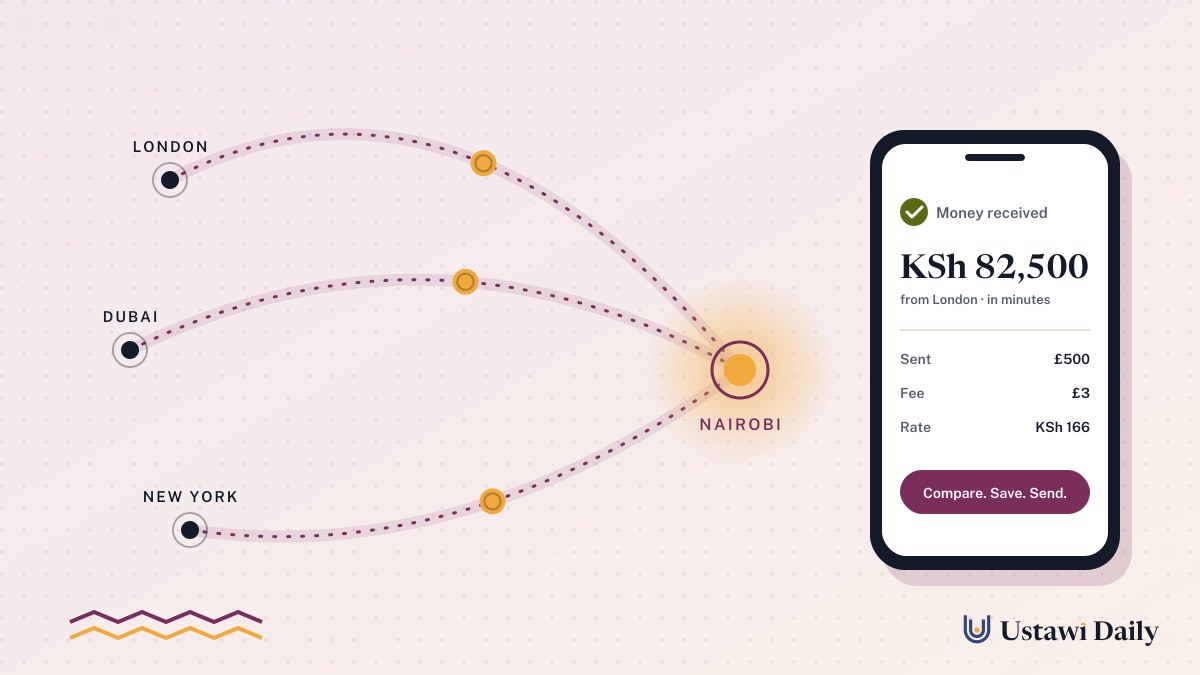
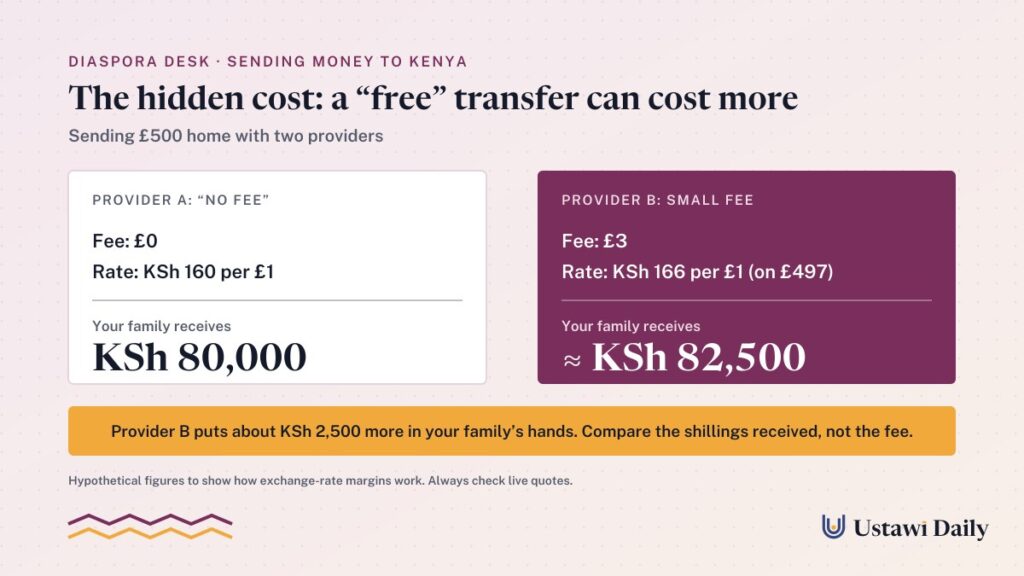
An example (hypothetical figures, to show how it works): you want to send £500. Provider A charges no fee but gives you KSh 160 per pound, so your family receives KSh 80,000. Provider B charges a £3 fee but gives you KSh 166 per pound on the remaining £497, so your family receives about KSh 82,500. The “free” option costs your family about KSh 2,500 more.
The simple rule: compare the final amount in Kenyan shillings your recipient will receive for the same amount sent. That single number captures both costs.
How the main ways to send money compare
| Method | Typical cost | Speed | Good to know |
|---|---|---|---|
| Online or app transfer to M-Pesa or a bank account | Usually the lowest | Often minutes to same day | Pay from your bank account or card. Compare exchange rates between apps. |
| Money transfer agent, paid in cash | Usually higher | Often fast, with cash pickup | Convenient without a bank account, but in the US cash payments now attract a 1% tax. |
| Bank-to-bank international transfer | Often the highest for small amounts | Usually 1 to 5 working days | Can suit very large transfers, such as a land purchase, but check both banks’ fees and the rate. |
| Informal channels (cash carried by friends, unlicensed agents) | Varies | Varies | Risky: no protection if money is lost or stolen. Avoid. |
These are general patterns. Prices vary by provider, sending country and amount, and they change often, so always check a live quote before sending.
New in 2026: the US 1% remittance tax
Because the United States is the largest source of remittances to Kenya, this matters to many readers. It applies only to money sent from the United States. Since 1 January 2026, the US has charged a 1% federal excise tax on international money transfers paid with cash, a money order, a cashier’s cheque or a similar physical instrument. The provider collects it from the sender at the time of the transfer.
Transfers funded from a US bank account or a US-issued debit or credit card are exempt. In practice, if you send from the US, paying digitally rather than in cash avoids the tax entirely. On a US$500 cash transfer, the tax would be US$5, on top of any fees.
8 ways to cut the cost of sending money to Kenya
- Compare the amount received, not the fee. Get quotes from two or three providers for the same amount and pick the one that delivers the most shillings. The World Bank’s free Remittance Prices Worldwide website also shows typical costs by provider for routes such as the UK or US to Kenya. Its data is updated quarterly, so confirm the live price with the provider.
- Send digitally. Online and app transfers are usually far cheaper than banks or cash agents.
- Pay from your bank account or debit card rather than in cash. In the US, this also avoids the 1% remittance tax.
- Check the exchange rate against the mid-market rate. A gap of a few percent is a hidden fee.
- Send larger amounts less often, if your budget allows. Many fees are partly fixed, so fewer transfers can mean lower total costs.
- Think about the receiving end. Sending straight to M-Pesa or a bank account is convenient, but withdrawal charges in Kenya can apply, so factor them in. Mobile money accounts also have transaction and balance limits, so send large amounts to a bank account instead.
- Watch for introductory offers, but compare the normal price you will pay afterwards.
- Use a reputable, licensed provider regulated in the country you send from. Cheap is no saving if your money is lost.
Stay safe when sending money home
- Double-check the recipient’s details, especially phone numbers for M-Pesa transfers. Mistakes can be hard to reverse.
- Never send money to someone you have only met online, or because of an urgent request you cannot verify. Call the person on a number you already know.
- Be wary of unusually good exchange rates offered by individuals or unlicensed agents.
- Keep receipts and transaction references for every transfer.
- For large sums such as land or property purchases, send money only after completing proper checks, and pay through an advocate’s client account rather than directly to a seller.
Make your money work once it arrives
Many diaspora families now use remittances to build wealth, not just cover expenses. If you are saving towards a bigger goal back home, consider where the money waits in the meantime:
- A money market fund in Kenya can earn interest while you save towards a purchase.
- If you are buying land, follow our guide on how to verify a title deed in Kenya from abroad before sending any deposit.
- To keep family members covered for health care, see our guide to SHA in Kenya, which you can pay for from abroad.
Frequently asked questions
What is the cheapest way to send money to Kenya?
Digital transfers, made online or through an app and paid from a bank account or debit card, are usually the cheapest. Compare the final amount in shillings your recipient will receive across two or three licensed providers before sending.
How much does it cost to send money to Kenya?
It varies by provider and method. The World Bank found that sending US$200 to Sub-Saharan Africa cost an average of 8.46% in late 2025, while digital transfers globally averaged 4.59%. Banks are usually the most expensive.
Is there a tax on sending money from the US to Kenya?
Since 1 January 2026, the US charges a 1% tax on transfers paid in cash, by money order or by cashier’s cheque. Transfers funded from a US bank account or a US-issued debit or credit card are exempt.
Why does the exchange rate matter so much?
Providers often convert your money at a rate below the mid-market rate. The difference is a hidden cost, which can be bigger than the transfer fee itself.
How long does it take to send money to Kenya?
Digital transfers to M-Pesa or a bank account often arrive within minutes or the same day. Bank-to-bank international transfers can take one to five working days.
Read next
- How to invest in Treasury bills and bonds in Kenya from abroad
- Money market funds in Kenya explained: how they work and how to choose one
- More practical guides on our Diaspora Desk
- How to invest in Kenya from abroad: the complete guide
Have a question about sending or investing money back home? Email editor@ustawidaily.com with the subject “Question,” and we’ll answer the most common ones in future guides.
Sources: Central Bank of Kenya remittance data and weekly bulletins; World Bank Remittance Prices Worldwide (Issue 54, Q3 2025 data); United Nations Sustainable Development Goal 10.c; US Department of the Treasury and Internal Revenue Service guidance on the remittance transfer excise tax. Last reviewed: October 2026.
This article is general information, not financial or tax advice. Fees, exchange rates and rules change often. Check current terms with your provider, and seek professional advice for large transfers or tax questions.