Money Market Fund Rates in Kenya: Top Funds This Week (2026)
FINANCE · PERSONAL MONEY
Money market fund rates in Kenya are falling, and the gap between the best and worst funds is wide: this week, the top fund paid more than double the lowest. Here are the latest rates, what you will really earn after tax, and how to choose a fund wisely. Updated weekly.
Rates as published on 16 October 2026. Money market funds (MMFs) remain one of Kenya’s most popular ways to save, for families at home and for Kenyans abroad. But the rates have come down over the past year, and choosing the right fund matters more. This page tracks the latest money market fund rates in Kenya, explains what is driving them, and shows you how to compare funds properly.
Key takeaways
- The average return across 26 money market funds was 9.3% after fees as of 15 October 2026, down from 9.9% a year earlier (Business Daily).
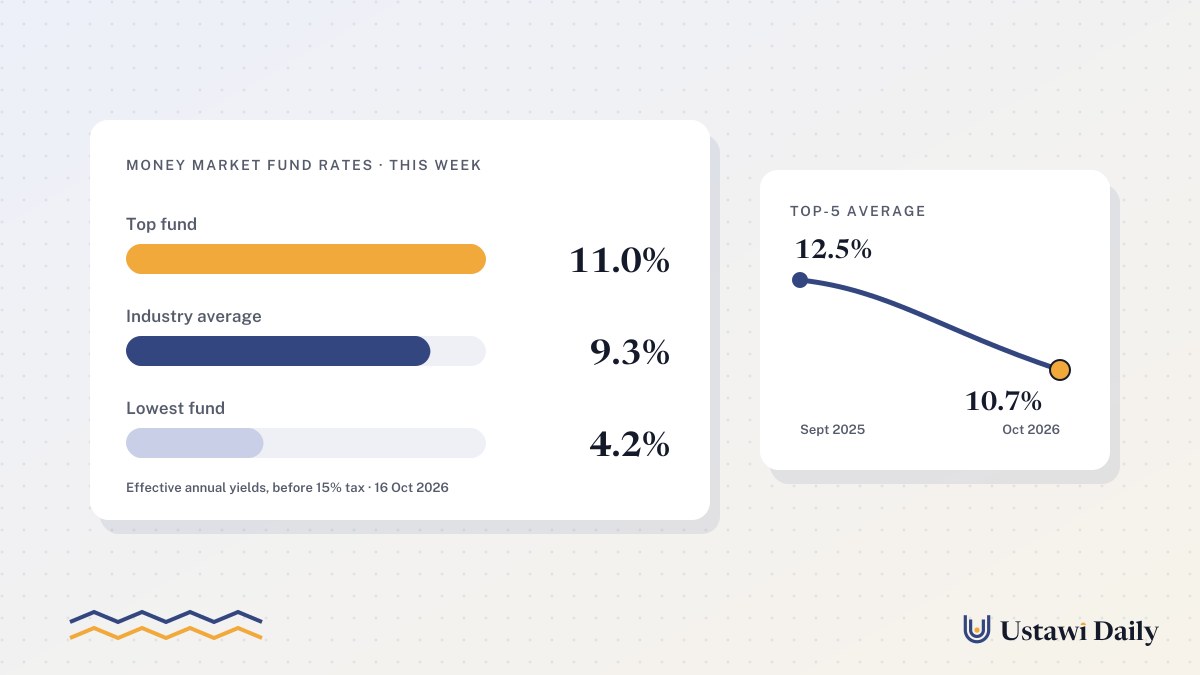
- The highest-yielding funds this week paid about 11.0%, while the lowest paid as little as 4.2%, out of 34 funds tracked.
- Published rates are before the 15% withholding tax: an 11.0% fund pays you about 9.35% after tax.
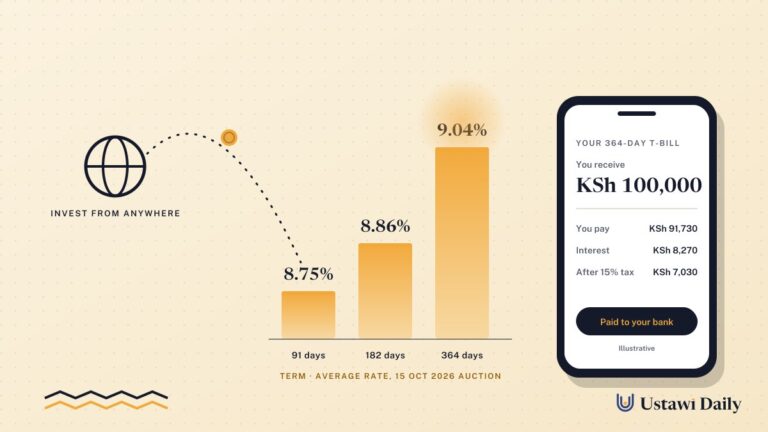
- Rates are falling mainly because one-year Treasury bill yields and bank deposit rates have eased. The 364-day T-bill cleared at 9.04% on 15 October, down from 9.39% a year earlier.
- Be wary of websites showing 15% to 18% for money market funds. Those figures are outdated or refer to riskier products.
- For Kenyans abroad, the shilling has been stable (down only about 0.5% against the US dollar in a year), so most of the return has held in dollar terms too.
Money market fund rates in Kenya this week
The table below shows the highest and lowest yields among 34 shilling money market funds, as published on 16 October 2026 in Cytonn’s weekly table, which uses Business Daily’s industry data. Rates are effective annual yields, which are typically net of management fees but before the 15% withholding tax.
| Fund | Effective annual yield | Approx. after 15% tax |
|---|---|---|
| Cytonn Money Market Fund | 11.0% | 9.35% |
| Faulu Money Market Fund | 10.8% | 9.18% |
| Lofty-Corban Money Market Fund | 10.6% | 9.01% |
| Industry average, 26 funds (Business Daily)* | 9.3% | 7.91% |
| Ziidi Money Market Fund | 6.2% | 5.27% |
| Stanbic Money Market Fund | 5.3% | 4.51% |
| Equity Money Market Fund | 4.2% | 3.57% |
*Business Daily’s average is calculated separately from the weekly table and may treat fees slightly differently, so treat it as a guide. Rates change daily. Cytonn, which compiles the weekly table, manages the fund at the top of it; the figures it publishes come from Business Daily’s industry data. Always confirm a fund’s latest yield on its own website or factsheet before investing.
Of the 26 funds in Business Daily’s tally, 20 paid less than a year ago and only six paid more. The number of funds paying double digits slipped from 14 to 13.
Why money market fund rates in Kenya are falling
Money market funds invest mainly in Treasury bills, bank deposits and other short-term, low-risk instruments, so their returns follow those rates, usually with a lag of a few weeks.
- One-year Treasury bill rates have eased. At the Central Bank of Kenya’s auction on 15 October 2026, the 364-day bill cleared at 9.04%, down from 9.39% a year earlier. Shorter 91-day bills actually pay more than a year ago (8.75%, up from 7.89%), so the fall is in longer-dated bills.
- The policy rate is on hold. The CBK kept its Central Bank Rate at 8.75% on 7 October 2026.
- Bank deposit rates have slipped. The average deposit rate fell to 6.91% in August 2026, from 7.13% in December 2025, according to the CBK.
The trend is clear at the top of the table: the average of the five highest-yielding funds was 10.7% this week, compared with 12.5% at the end of September 2025.
What you will really earn: a worked example
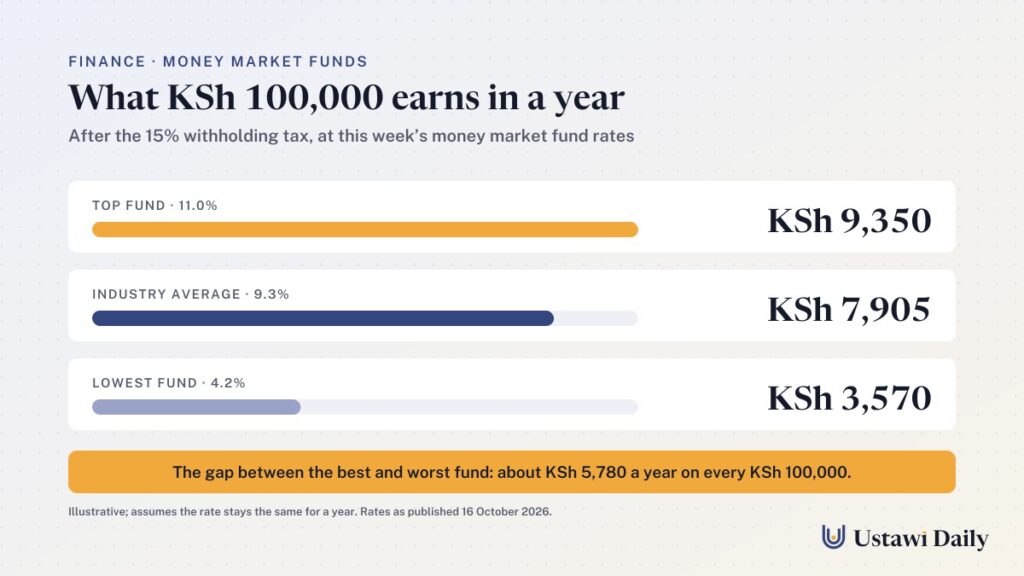
Here is roughly what KSh 100,000 would earn over a year at this week’s rates, if the rate stayed the same:
| Fund yield | Interest before tax | Less 15% tax | You keep |
|---|---|---|---|
| 11.0% (top fund) | KSh 11,000 | KSh 1,650 | KSh 9,350 |
| 9.3% (average) | KSh 9,300 | KSh 1,395 | KSh 7,905 |
| 4.2% (lowest) | KSh 4,200 | KSh 630 | KSh 3,570 |
Illustrative only. Yields change daily, so actual earnings will differ.
The difference between the best and worst fund is about KSh 5,780 a year on every KSh 100,000. On KSh 1 million, that becomes about KSh 57,800 a year, which is why comparing funds is worth a few minutes of your time.
How to read money market fund rates in Kenya correctly
- Effective annual yield is the headline figure. It assumes daily interest is reinvested for a full year. Some funds also publish a lower “daily yield”, which is the rate before compounding.
- Management fees are usually already deducted from published yields, so you do not subtract them again. Check the fund’s factsheet to confirm.
- Tax is not deducted. Interest is subject to a 15% withholding tax, which the fund deducts at source.
- Rates are variable. Today’s top fund may not be top next month. A fund that stays near the top for many weeks is a better sign than one good week.
Warning: be wary of 15% to 18% “rates”
Some comparison websites still show money market funds paying 15% to 18% or more. No shilling money market fund is paying that today: the highest published yield this week was about 11%. Those figures are usually outdated, often dating from 2024, when rates were much higher, or they belong to special funds, which invest in riskier assets such as unlisted shares and offshore stocks.
Special funds can pay more, but they can also lose money. Make sure you know exactly which product you are buying.
How to choose a money market fund in Kenya
Yield matters, but it should not be the only test. Check these too:
- CMA licence. Confirm on the Capital Markets Authority website that the fund is a licensed collective investment scheme, and that you are investing in that fund itself, not a different, unregulated product from the same group.
- Consistency. Look at the fund’s yield over several months, not just this week.
- Size and track record. Larger, established funds can usually handle big withdrawals more easily.
- Withdrawal speed. Most funds pay out within one to three working days. Check before you need the money.
- Minimum investment and access. Some funds start from KSh 100 to KSh 1,000 and offer app or M-Pesa top-ups.
- Who the custodian is. A licensed custodian, usually a bank, holds the fund’s assets separately from the fund manager, which helps protect your money if the manager runs into trouble.
For a full explanation of how these funds work, see our guide to money market funds in Kenya.
For Kenyans abroad
Many Kenyan money market funds accept investors living abroad, with online sign-up and deposits by international bank transfer. You will usually need a national ID or passport and a KRA PIN; check each fund’s requirements.
Currency matters as much as the rate. Over the past year the shilling has been stable, moving from about KSh 128.2 to KSh 128.84 per US dollar (as of 16 October 2026), a fall of only about 0.5%. On those numbers, a 9.3% shilling return was worth roughly 8.8% in dollar terms before tax and transfer costs. That will not always be the case: a sharp fall in the shilling can wipe out a year’s interest.
Some fund managers also offer US-dollar money market funds, which protect you from shilling movements but pay much less: in September 2026 they averaged about 4.9%, with the highest just over 6%, according to one industry tracker.
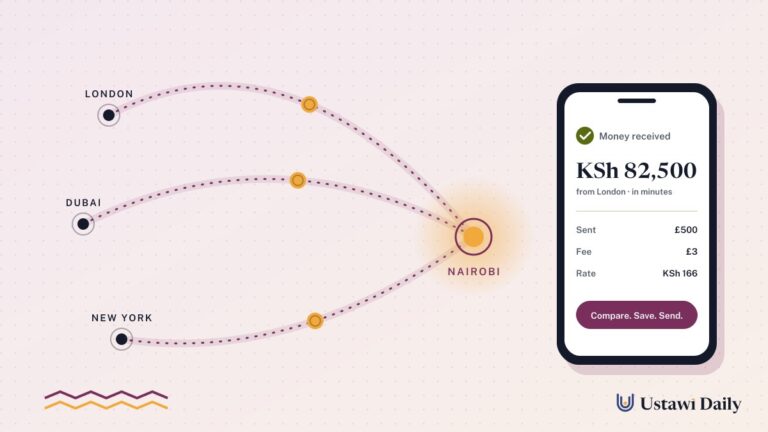
When you send money to invest, compare transfer costs first. See our guide on how to send money to Kenya for less.
Money market funds vs Treasury bills vs bank deposits
| Option | Latest rate | Access to your money |
|---|---|---|
| Money market fund (industry average) | 9.3% (after fees, before tax) | Usually 1 to 3 working days |
| 364-day Treasury bill | 9.04% (before tax) | At maturity, after one year |
| Bank deposits (average) | 6.91% (August 2026) | Depends on the account |
These rates are calculated in slightly different ways, so treat the comparison as a guide.
Money market funds still beat the average bank deposit and offer more flexibility than Treasury bills. If you can lock money away for a year, compare with our guide to investing in Treasury bills in Kenya.
The bigger picture
Kenya’s unit trust industry keeps growing. The Capital Markets Authority reported total assets of KSh 948.7 billion at the end of June 2026, with money market funds holding KSh 459.9 billion, or 48.5% of the total.
The fastest growth is now in special funds, whose share rose to 26.6% from 23.9% in a single quarter. Industry analysts say many savers are chasing higher returns as money market fund rates in Kenya fall, which brings higher risk.
Frequently asked questions
Which money market fund has the highest rate in Kenya this week?
In the table published on 16 October 2026, Cytonn Money Market Fund led at about 11.0%, followed by Faulu at 10.8% and Lofty-Corban at 10.6%. Rates change daily, so check the fund’s latest figure before investing.
What is the average money market fund rate in Kenya?
The average across 26 funds was 9.3% after fees as of 15 October 2026, according to Business Daily, down from 9.9% a year earlier.
Are money market fund rates in Kenya before or after tax?
Published money market fund rates in Kenya are after management fees but before the 15% withholding tax. To estimate what you keep, multiply the rate by 0.85.
Why do money market fund rates differ so much?
Funds hold different mixes of Treasury bills, bank deposits and other instruments, charge different fees, and take slightly different risks. In this week’s table, several funds linked to banks and mobile platforms were near the bottom, though they may offer convenience.
Is my money safe in a money market fund?
Money market funds are considered low-risk, and licensed funds are supervised by the Capital Markets Authority, with assets held by a separate custodian. But they are not risk-free, and returns are not guaranteed.
How often is this page updated?
We update the money market fund rates in Kenya on this page every week, as new industry data is published.
Read next
- Money market funds in Kenya explained: how they work and how to choose one
- How to invest in Treasury bills and bonds in Kenya from abroad
- Sending money to Kenya: how to cut remittance costs
Want these rates in your inbox? Join The Ustawi Weekly, our free weekly newsletter.
Sources: Business Daily, average returns on MMFs, 18 October 2026; Cytonn Weekly #41 (money market fund yields as published on 16 October 2026); Central Bank of Kenya, Monetary Policy Committee decision, 7 October 2026; Central Bank of Kenya Treasury bill auction results and weighted average deposit rates; Capital Markets Authority, Collective Investment Schemes Quarterly Report for the period ended 30 June 2026. Rates last reviewed: 20 October 2026.
This article is general information, not financial advice. Ustawi Daily has no commercial relationship with any fund mentioned. Past returns do not guarantee future returns. Check current rates and terms with the fund manager, and consider speaking to a licensed financial adviser.