Diaspora Mortgage in Kenya (2026): Deposits, Rates, Repayments and Risks
DIASPORA DESK · PROPERTY
You can buy or build a home in Kenya with a mortgage while living abroad, but diaspora mortgages come with bigger deposits, shorter terms and interest rates far higher than in the UK, US or Europe. Here is how a diaspora mortgage in Kenya works, what it really costs, and how to decide whether it makes sense for you.
For many Kenyans abroad, saving the full price of a home in cash takes years. A mortgage can bring the goal forward. Several Kenyan banks run dedicated diaspora mortgage products, and you can usually apply without living in Kenya, as long as the property you are buying is in Kenya.
But a mortgage is a long, expensive commitment, and Kenyan rates are high by international standards. This guide explains how a diaspora mortgage in Kenya works, what lenders ask for, what you might repay, and the risks to weigh before you sign.
Key takeaways
- Several Kenyan banks offer diaspora mortgages to Kenyans living abroad, secured on property in Kenya.
- Expect a larger deposit than residents pay: KCB, for example, lends diaspora customers up to 70% of the property’s value, meaning roughly a 30% deposit.
- Terms are often shorter: KCB’s maximum is 20 years for diaspora customers, against 25 for residents.
- Published 2026 comparisons put standard Kenyan mortgage rates at roughly 12% to 16% a year, and rates are usually variable.
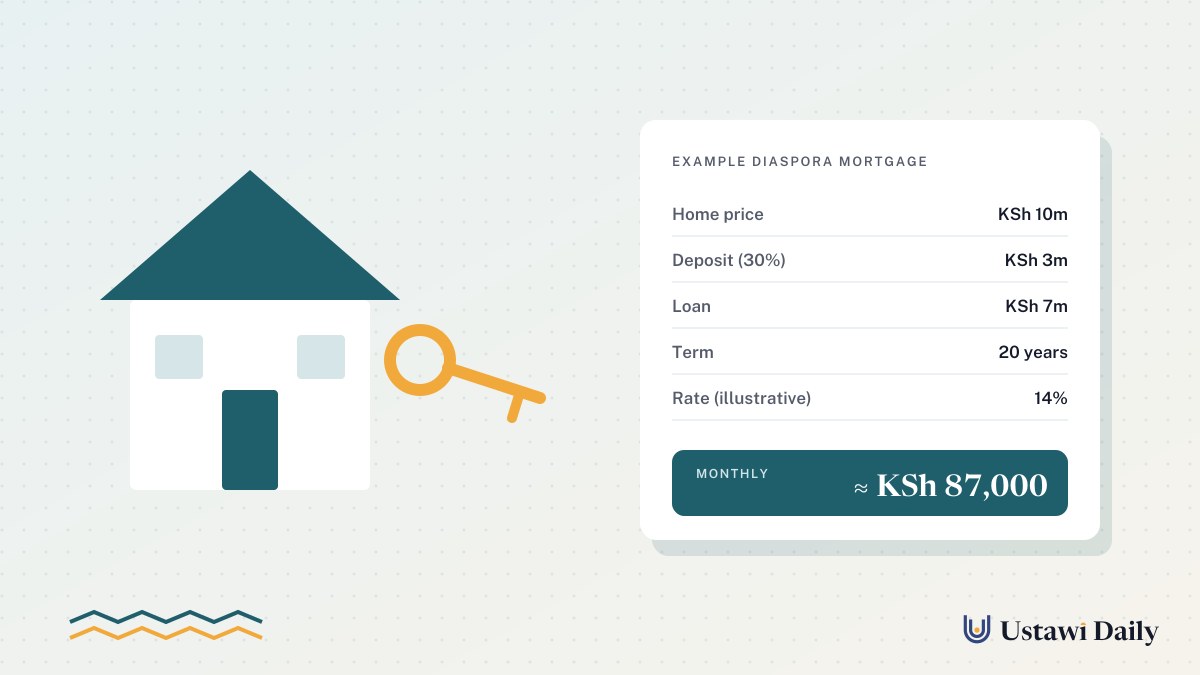
- On a KSh 7 million loan over 20 years at 14%, the monthly repayment is about KSh 87,000, and total interest is nearly KSh 14 million.
- Earning in one currency and repaying in shillings adds currency risk.
How a diaspora mortgage in Kenya works
A diaspora mortgage is a home loan from a Kenyan bank to a Kenyan living abroad, secured on a residential property in Kenya. You can use it to buy a finished home, buy off-plan from a developer, or in some cases build on land you already own.
The bank lends part of the property’s value, you pay the rest as a deposit, and you repay the loan with interest in monthly instalments, usually from an account you hold with the bank. The bank registers a charge over the property, so it can sell it if you stop paying.
What lenders typically require
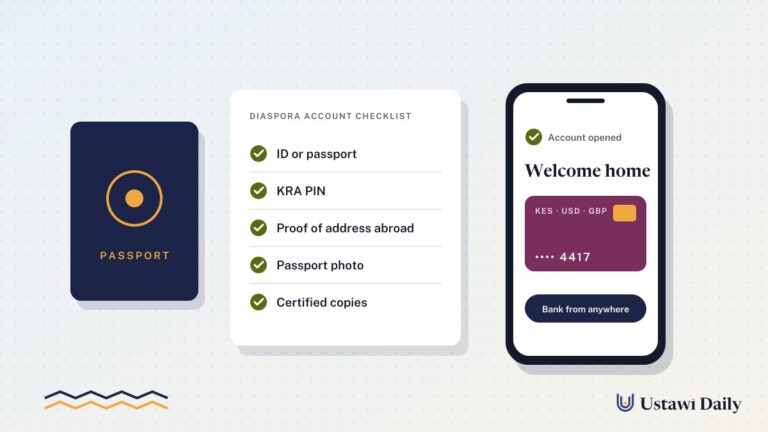
- Proof of identity: a Kenyan passport or national ID.
- A KRA PIN.
- Proof of income abroad: typically an employment letter, recent payslips and bank statements. Self-employed applicants usually need accounts and tax returns.
- Proof of address abroad and, in some cases, a credit report from your country of residence.
- An account with the lender, in shillings or foreign currency, from which repayments are taken. See how to open a bank account in Kenya from abroad.
- Property documents: a sale agreement, the title (or developer documents for off-plan), and a valuation by a valuer the bank approves.
- For construction loans: approved plans, a Bill of Quantities, environmental approval or exemption where required, and contractor’s all-risk insurance.
Lenders also check that you can afford the repayments. KCB, for example, says it uses 50% of gross income when assessing a diaspora customer’s ability to repay. Each bank has its own rules, so compare carefully.
Deposits, terms and rates
| Feature | What to expect |
|---|---|
| Deposit | Often 20% to 30% or more for diaspora buyers. KCB’s diaspora product lends up to 70% of the lower of the price and the bank’s valuation. |
| Maximum term | Can be shorter for diaspora buyers. KCB, for example, allows up to 20 years for diaspora customers and up to 25 years for residents. |
| Interest rate | Published 2026 comparisons put standard rates at roughly 12% to 16% a year, usually variable and linked to the bank’s base rate. |
| Affordable-housing loans | Loans refinanced through the Kenya Mortgage Refinance Company (KMRC) can be cheaper, but are aimed at lower-priced homes and lower-to-middle incomes, and may not suit most diaspora buyers. |
Rates and terms change and vary by lender and borrower. Always get a written offer showing the rate, all fees and the total cost of the loan.
For context, the Central Bank of Kenya held its policy rate at 8.75% in October 2026. Mortgage rates sit well above that, because they include the bank’s costs and its assessment of risk.
What you would actually repay
Here is an example: a KSh 10 million home with a 30% deposit (KSh 3 million), leaving a KSh 7 million loan repaid over 20 years:
| Interest rate | Monthly repayment | Total repaid over 20 years | Total interest |
|---|---|---|---|
| 12% | About KSh 77,100 | About KSh 18.5 million | About KSh 11.5 million |
| 14% | About KSh 87,000 | About KSh 20.9 million | About KSh 13.9 million |
| 16% | About KSh 97,400 | About KSh 23.4 million | About KSh 16.4 million |
Illustrative, assuming a fixed rate for the whole term. Real mortgages are usually variable, so repayments can rise or fall, and fees and insurance are extra.
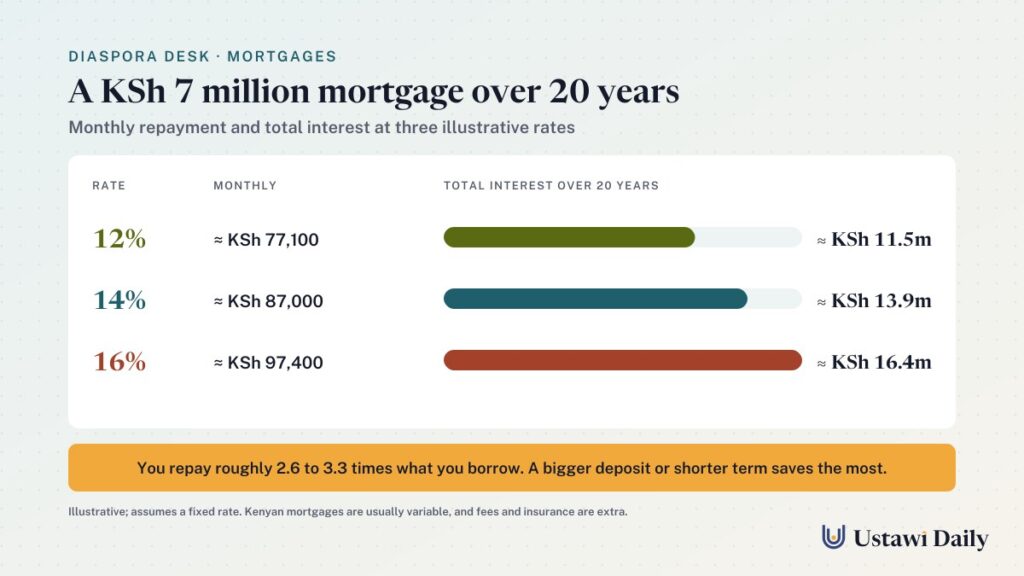
What the table shows: at these rates, you would repay roughly two and a half to more than three times the amount you borrow. A larger deposit, a shorter term or extra repayments when you can afford them all cut the total interest significantly.
Costs beyond the interest
- Your deposit and the usual buying costs: stamp duty, legal fees and more. See the real cost of buying land in Kenya.
- Bank fees: arrangement or processing fees, and the bank’s valuation fee.
- Legal fees for the charge, and stamp duty on the charge document.
- Insurance: lenders usually require property insurance and life or mortgage protection cover for the life of the loan.
The risks to weigh
- Currency risk. If you earn in pounds, dollars or euros and repay in shillings, exchange-rate movements change how much of your income goes on repayments. Some lenders offer foreign-currency accounts; ask how repayments and the loan itself are denominated.
- Rising rates. Kenyan mortgages are usually on variable rates, so repayments can increase.
- Losing your income abroad. Job loss or a move can make repayments hard. Missed payments damage your credit record and can lead to the bank selling the property.
- Off-plan risk. If you buy off-plan, delays or a developer’s failure can leave you paying for a home that is not finished. Check the developer carefully.
- Rental returns after tax. If you plan to let the home out to cover the mortgage, remember that non-resident landlords now pay 30% of gross rent. See taxes for Kenyans abroad.
Alternatives to a diaspora mortgage
- Save and buy in cash, holding savings in a money market fund while you build up the price.
- Build in stages on land you own, paying as you go. See building a house in Kenya from abroad.
- Borrow through a SACCO, if you are a member; SACCOs often lend several times your deposits. See SACCO dividend rates in Kenya.
- Combine savings with a smaller mortgage, borrowing less and repaying faster.
How to apply for a diaspora mortgage in Kenya: step by step
- Work out what you can afford, including a buffer for higher rates and currency moves.
- Compare at least three lenders on rate, fees, deposit, term and insurance requirements.
- Get an agreement in principle so you know how much you can borrow before you commit to a property.
- Choose and verify the property: run official searches, and check the developer if buying off-plan. See how to verify a title deed in Kenya.
- Submit your full application with all documents. The bank values the property.
- Review the offer letter with your own advocate before signing.
- Complete: pay the deposit and costs, the bank registers its charge, and the funds are released.
Frequently asked questions
Can Kenyans abroad get a mortgage in Kenya?
Yes. Several Kenyan banks offer diaspora mortgages to Kenyans living abroad, secured on residential property in Kenya, subject to proof of income and the bank’s other requirements.
How much deposit do I need for a diaspora mortgage in Kenya?
Often 20% to 30% or more. KCB, for example, lends diaspora customers up to 70% of the property’s value, meaning a deposit of about 30%.
What are mortgage interest rates in Kenya in 2026?
Published comparisons put standard rates at roughly 12% to 16% a year, usually variable. Get a written offer from each lender, as rates depend on the product and your profile.
Can I use a diaspora mortgage to build a house?
Some lenders offer construction mortgages, usually requiring approved plans, a Bill of Quantities, environmental approval or exemption where needed, and insurance, with money released in stages.
Is it better to buy with cash or a mortgage?
It depends on your savings, income stability and plans. At rates of 12% to 16%, a 20-year mortgage means repaying roughly two and a half to more than three times the amount borrowed, so it is worth considering a larger deposit, or a mix of savings and a smaller loan.
Read next
- Building a house in Kenya from abroad
- The real cost of buying land in Kenya
- How to invest in Kenya from abroad: the complete guide
Considering a mortgage from abroad and have a question? Email editor@ustawidaily.com with the subject “Question,” and we’ll answer the most common ones in future guides.
Sources: KCB Bank diaspora mortgage terms; Central Bank of Kenya Monetary Policy Committee decisions; Kenya Mortgage Refinance Company; published 2026 comparisons of Kenyan mortgage rates. Repayment figures are Ustawi Daily calculations. Last reviewed: 28 October 2026.
This article is general information, not financial advice. Ustawi Daily has no commercial relationship with any lender mentioned. Mortgage terms vary; get written offers and independent advice before borrowing.