Silage Making in Kenya (2026): How to Cut Dairy Feed Costs With Silage and Hay
AGRIBUSINESS · LIVESTOCK & DAIRY
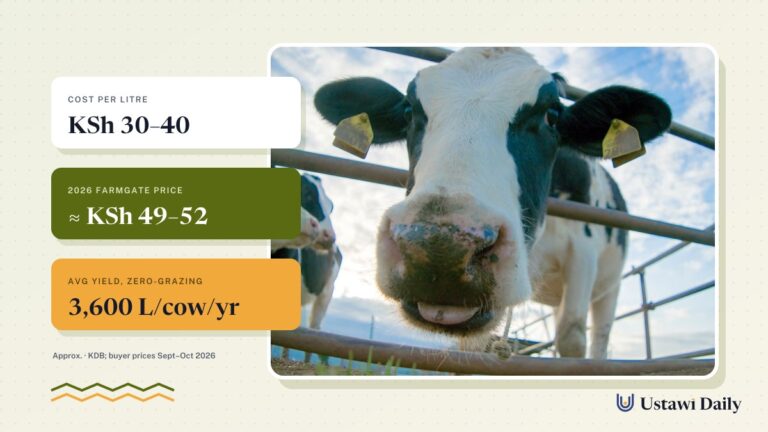
Feed is the biggest cost in dairy farming, and in the dry season it can wipe out a farm’s profit. Farmers who conserve fodder when it is plentiful can feed their cows for a fraction of the cost of buying hay or silage later. Here is a practical guide to silage making in Kenya, hay, and how to work out what your cows really need.
Every dry season, the same story repeats. Pasture dries up, hay and silage prices rise, and dairy farmers either pay more for feed or watch milk yields fall. In 2026, farmers in the North Rift reported feed prices up by about a third during the long dry spell.
Farmers who cope well with dry seasons tend to share one habit: they conserve feed when it is cheap and plentiful, as silage or hay, and feed it when it is scarce. This guide shows how, and why it can transform your costs. If you are new to the numbers behind dairy, start with our guide to whether dairy farming in Kenya is profitable.
Key takeaways
- Feed is usually the largest cost of producing milk. Studies and farm guides commonly put it at around half or more of total costs.
- Compare feeds by dry matter, not by the bale or kilo. Silage contains far more water than hay, so a “cheap” kilo of silage and an “expensive” bale of hay can be misleading.
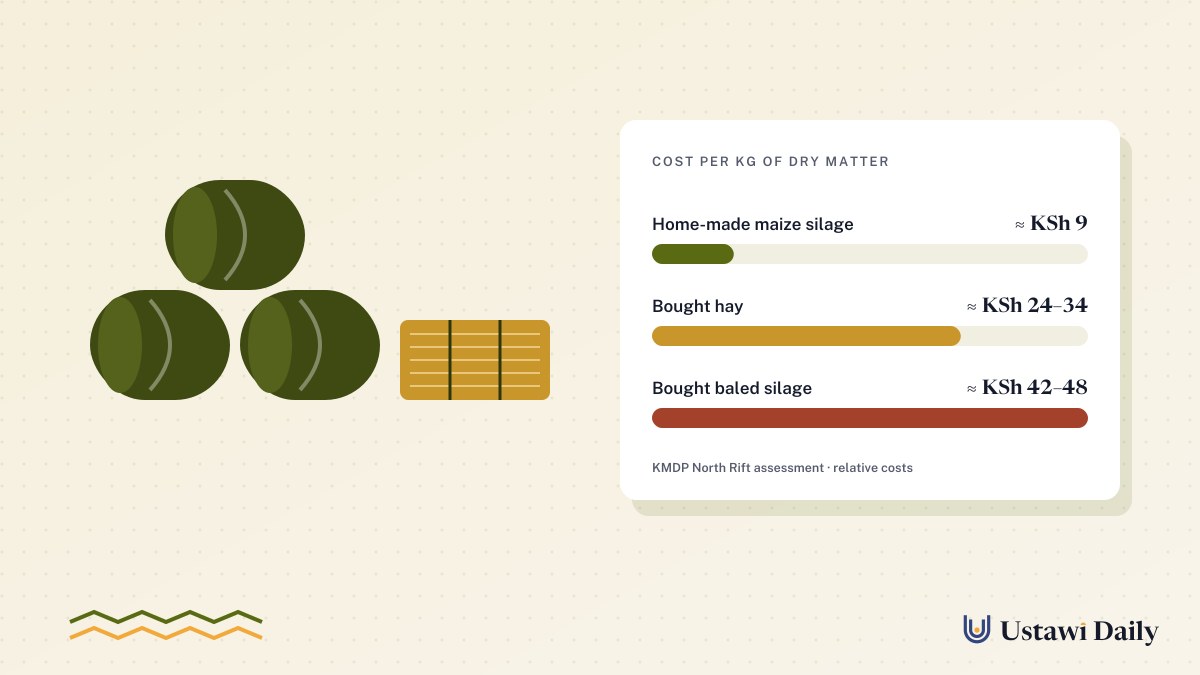
- In a North Rift field assessment, home-made maize silage cost about KSh 9 per kg of dry matter, compared with about KSh 24 to 34 for bought hay and KSh 42 to 48 for bought baled silage.
- Good silage depends on three things: harvesting at the right stage, chopping and compacting well, and sealing it completely airtight.
- Plan how much to conserve: a cow eats roughly 3% of her body weight in dry matter a day.
Why conserving feed changes the economics of dairy
Fodder is cheap when it is plentiful, after the rains, and expensive when it is scarce. Hay that sells cheaply after harvest can cost far more per bale in the dry season. Farmers who must buy feed at peak prices see their cost per litre jump, often just when milk prices are uncertain.
Conserving your own feed does three things:
- It lowers your feed cost, because you pay the cost of growing and preserving, not the dry-season market price.
- It keeps milk yields steady through the dry season, protecting your income.
- It protects you from shortages, when feed may not be available at any price.
The key insight: compare feeds by dry matter
All feeds contain water. Cows get their nutrition from the dry matter: what remains when the water is removed. Hay is mostly dry matter, roughly 80% or more. Maize silage is often only about 30% dry matter. So a kilo of silage contains far less feed than a kilo of hay.
This is why prices per kilo or per bale can mislead. A field assessment of maize silage in the North Rift, carried out for the Kenya Market-led Dairy Programme, compared the cost of feeds per kilogram of dry matter:
| Feed | Approximate cost per kg of dry matter |
|---|---|
| Home-made maize silage (about 15 tonnes of fresh silage per acre) | About KSh 9 |
| Bought hay (13 kg bales at KSh 250 to KSh 350) | About KSh 24 to KSh 34 |
| Bought baled maize silage | About KSh 42 to KSh 48 |
Source: Kenya Market-led Dairy Programme assessment of forage interventions in the North Rift. Prices date from that assessment and have risen since, so treat these as a guide to the relative costs, not current prices.
What this shows: making your own maize silage, with a good yield, cost a fraction of buying feed in. The assessment also found that the higher your yield per acre, the lower your cost per kilo, so good crop management matters as much as silage-making skill.
Silage making in Kenya: step by step
Silage is green fodder preserved by fermentation in the absence of air. Maize is the most common silage crop in Kenya, but Napier grass, sorghum and other fodders can also be used.
- Grow a good crop. Yield drives cost. The Kenya Agricultural and Livestock Research Organization (KALRO) has developed fodder maize varieties suited to different areas, including drought-tolerant types for drier regions. Ask your county extension officer which varieties suit your area.
- Harvest at the right stage. For maize, this is usually when the grain is at the milky to dough stage, when the whole plant has enough dry matter to ferment well. Napier grass is best cut young and leafy, at roughly one metre tall.
- Chop finely. Short pieces, a few centimetres long, pack tightly and ferment well. Chaff cutters or silage-making service providers can do this.
- Add molasses where needed. Grasses such as Napier have less sugar than maize, so diluted molasses is often added to help fermentation.
- Compact hard. Press out as much air as possible, layer by layer, in a pit, bunker, tube or silage bag.
- Seal it completely airtight with heavy polythene, weighed down. Air is the enemy of silage: it causes heating, mould and losses.
- Let it ferment for about three weeks before opening.
- Feed out carefully. Open only a small face at a time, take what you need, and reseal. Never feed mouldy or rotten silage: it can make cows ill.
Silage making in Kenya is not only for large farms. Small farmers who lack machinery can use silage-making service providers, who bring the equipment and labour, or work together in groups to share costs.
Making and buying good hay
- Cut at the right time. Grasses such as Rhodes grass make the best hay when cut around early flowering, before they become stemmy and less nutritious.
- Dry it well before baling. Damp hay goes mouldy.
- Store it under cover, off the ground, protected from rain.
- Consider legumes such as lucerne (alfalfa), which provide much more protein than grass hay and can reduce the amount of dairy meal you need.
- If you buy hay, buy in bulk after harvest when prices are lower, check that bales are dry, green and leafy, and weigh some bales, as sizes vary.
How much feed do you need to conserve?
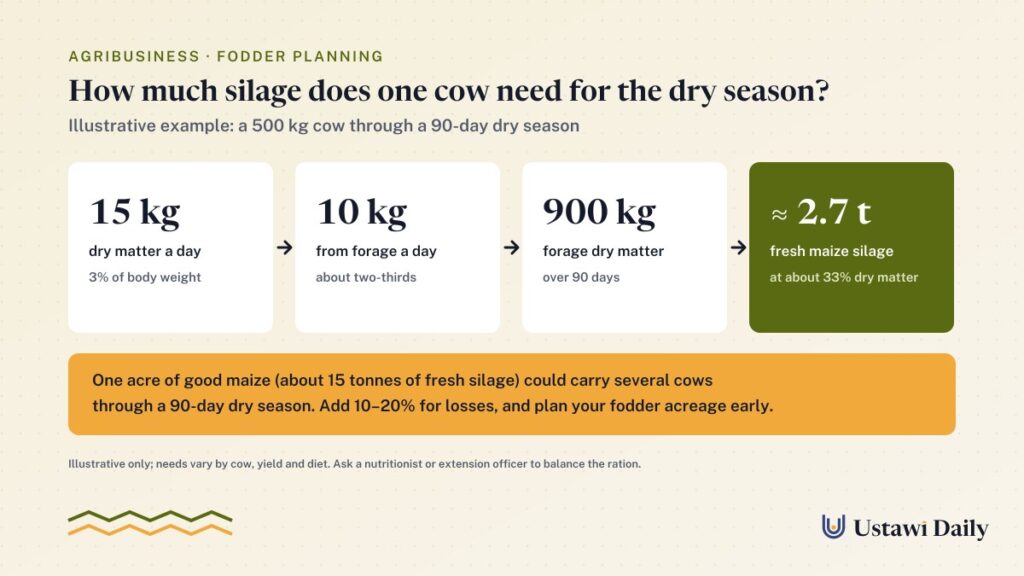
A simple rule of thumb: a dairy cow eats roughly 3% of her body weight in dry matter each day. Here is an illustrative calculation for one cow through a 90-day dry season:
| Step | Example |
|---|---|
| Cow’s weight | 500 kg |
| Daily dry matter intake (3%) | About 15 kg of dry matter |
| Share from forage (say two-thirds; the rest from dairy meal) | About 10 kg of dry matter a day |
| Forage dry matter for 90 days | About 900 kg |
| As maize silage (at about 33% dry matter) | About 2.7 tonnes of fresh silage |
Illustrative only. Needs vary with the cow’s size, milk yield and diet. Add 10% to 20% for losses, and ask a livestock nutritionist or extension officer to balance the full ration.
At a yield of around 15 tonnes of fresh silage per acre, one acre of good maize could provide dry-season forage for several cows. That is why planning your fodder acreage is a key decision on any dairy farm.
Common mistakes in silage making in Kenya
- Poor sealing: air gets in, the silage heats and moulds, and much of it is lost.
- Harvesting too early or too late: wet, immature fodder ferments badly; old, dry fodder is less nutritious and hard to compact.
- Chopping too coarsely: long pieces trap air.
- Opening too large a face: exposed silage spoils quickly.
- Feeding mouldy feed: risks animal health and milk quality.
- Not planning enough: running out halfway through the dry season means buying at peak prices anyway.
Managing a dairy farm from abroad?
Feed planning is one of the clearest ways an absentee owner can protect a dairy business. Agree a fodder plan with your farm manager before each season, budget for conservation, and ask for photos of sealed silage and stored hay. See our guide to agribusiness in Kenya from abroad for how to set up controls.
Frequently asked questions
How do I make silage in Kenya?
Harvest maize or another fodder at the right stage, chop it finely, add molasses for grasses, compact it hard in a pit, tube or bag, seal it completely airtight, and let it ferment for about three weeks before feeding.
Is silage cheaper than hay?
Home-made silage can be much cheaper per kilogram of dry matter. In a North Rift assessment, home-made maize silage cost about KSh 9 per kg of dry matter, against about KSh 24 to 34 for bought hay. Bought baled silage can be more expensive than hay.
How long does silage last?
Well-made silage that stays sealed and airtight can be stored for many months. Once opened, feed it steadily and reseal it, as exposure to air causes spoilage.
How much silage does a cow need?
It depends on the cow and her diet. As a rough guide, a 500 kg cow getting two-thirds of her dry matter from forage needs about 10 kg of forage dry matter a day, which is roughly 30 kg of fresh maize silage.
Can small-scale farmers make silage?
Yes. Small farmers can make silage in bags or tubes, and can use silage-making service providers or group arrangements to share equipment and costs.
Read next
- Is dairy farming in Kenya profitable? Costs and returns per cow
- Agribusiness in Kenya from abroad: what works and what fails
- More guides from our Agribusiness section
- How to invest in Kenya from abroad: the complete guide
Have a fodder or feeding question? Email editor@ustawidaily.com with the subject “Question,” and we’ll answer the most common ones in future guides.
Sources: Kenya Market-led Dairy Programme, assessment of forage interventions in the North Rift; CGIAR research on silage-making service providers in Kenya; Kenya Agricultural and Livestock Research Organization (KALRO); 2026 reporting on dry-season feed prices. Last reviewed: 28 October 2026.
This article is general information, not veterinary or nutritional advice. Feeding needs vary by animal and farm. Consult a veterinarian, livestock nutritionist or county extension officer for a ration suited to your herd.