How to Invest in Treasury Bills and Bonds in Kenya From Abroad (2026): A Step-by-Step Diaspora Guide
DIASPORA DESK · FINANCE
You don’t need to be in Kenya to lend to the Kenyan government and earn interest. Treasury bills and bonds can be bought online, from anywhere in the world, through the Central Bank of Kenya’s DhowCSD platform. Here is exactly how it works, what you can earn, and the risks to understand first.
Many Kenyans abroad want to invest back home but don’t know where to start, or worry about being cheated by people they can’t supervise from thousands of kilometres away. Government securities solve both problems. You deal directly with the Central Bank of Kenya (CBK), there is no middleman holding your money, and the minimum investment is within reach of many diaspora savers.
This guide explains how Treasury bills in Kenya and government bonds work, how to open an account and invest from abroad step by step, what returns and taxes to expect, and how they compare with other options.
Key takeaways
- Treasury bills are short-term government loans (91, 182 or 364 days). Treasury bonds run for years and usually pay interest every six months.
- You can invest from abroad through the CBK’s DhowCSD platform, online or via its mobile app. You need a Kenyan bank account in your name.
- The CBK’s minimum is KSh 50,000 in face value (the amount repaid at maturity) for standard, non-competitive bids, in multiples of KSh 50,000.
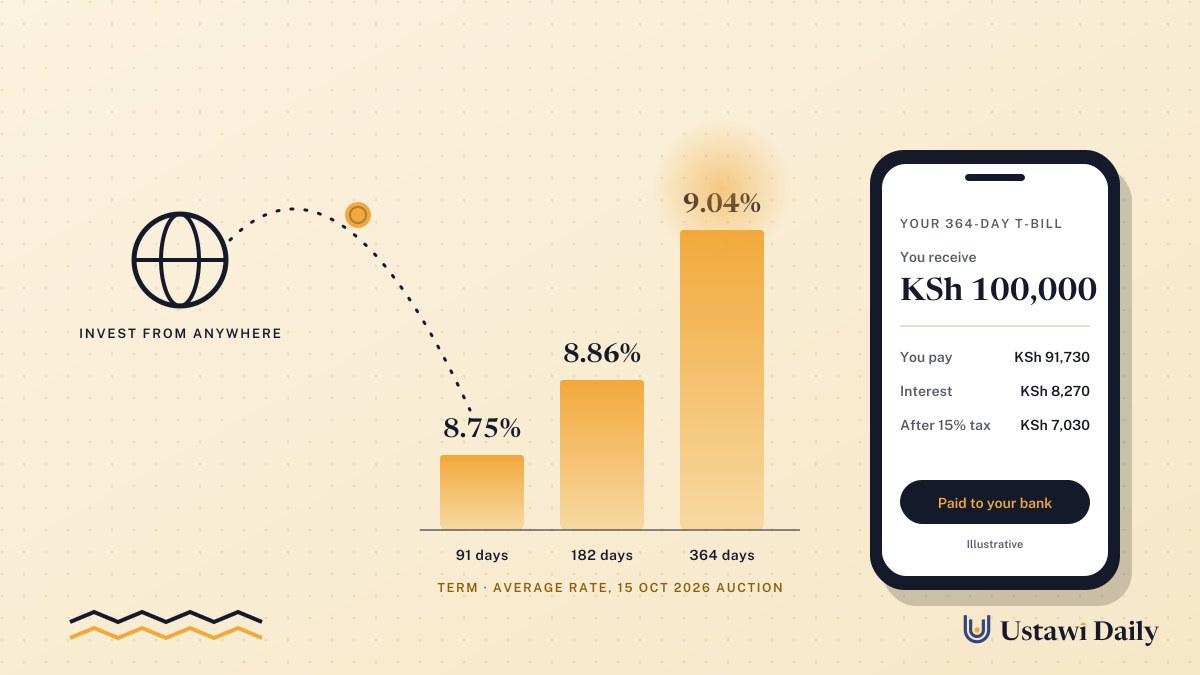
- At the mid-October 2026 auction, average rates were about 8.75% (91-day), 8.86% (182-day) and 9.04% (364-day). Rates change every week.
- Interest is usually subject to withholding tax, commonly 15% on Treasury bills. Each bond’s prospectus states its tax treatment.
- The biggest risk for diaspora investors is usually currency: returns are in shillings, so exchange-rate movements affect what your money is worth abroad.
What are Treasury bills and bonds in Kenya?
When you buy a Treasury bill or bond, you are lending money to the Government of Kenya, which borrows through the CBK to fund its budget. In return, the government pays you interest and repays your money when the security matures.
Treasury bills (T-bills) are short-term. They come in three terms: 91 days (about 3 months), 182 days (about 6 months) and 364 days (about 1 year). The CBK auctions all three every week. T-bills are sold at a discount: you pay less than the face value now and receive the full face value at maturity. The difference is your interest.
Treasury bonds are long-term, typically from 2 to more than 20 years. Most pay interest (called a coupon) every six months and return your full investment at the end. Bonds are offered through periodic auctions announced by the CBK, and many can later be traded on the Nairobi Securities Exchange.
Infrastructure bonds are a special type of Treasury bond used to finance public infrastructure. They have historically been exempt from withholding tax, which made them popular, but tax treatment can change, so always check the prospectus.
Can Kenyans abroad really invest?
Yes. The CBK states that both Kenyans and foreign investors can invest directly in government securities, provided they have a CSD account with the CBK and an account with a commercial bank in Kenya. Since the launch of DhowCSD, the whole process, from registration to bidding, is online.
That means you can open an account, place bids and track your investments from London, Dallas, Dubai or anywhere else, using your phone or computer.
What you need before you start
- A Kenyan national ID or passport
- A KRA PIN. It is mandatory for residents and needed for most bank and investment accounts in Kenya. Many Kenyans abroad already have one; if not, you can register online on KRA’s iTax portal.
- A Kenyan bank account in your exact name. Your interest and repayments are paid here, and it must match your DhowCSD details. Many Kenyan banks offer diaspora accounts that can be opened remotely.
- An email address and phone number in your name
- A clear passport-style photo
How to invest in Treasury bills in Kenya from abroad: step by step
- Open a DhowCSD account. Register only on the official portal, dhowcsd.centralbank.go.ke, or the official DhowCSD app from the Google Play Store or Apple App Store. Enter your details, upload your documents and add your Kenyan bank account.
- Wait for approval. Your Kenyan bank must confirm your account details, which usually takes a few working days. Once approved, you receive login details by email.
- Choose what to buy. T-bills are on offer every week. For bonds, check the CBK website or the DhowCSD app for upcoming auctions and read the prospectus, which gives the term, coupon, tax treatment and deadlines.
- Place a non-competitive bid. This is the simplest option for individuals: you accept the average rate set at the auction. Competitive bids, where you name your own rate, require at least KSh 2 million.
- Check your results and pay. After the auction, DhowCSD shows whether your bid succeeded, the amount payable and a payment key. For T-bills, the CBK requires payment by 2pm on the settlement date, usually the Monday after the auction. Send the money to your Kenyan bank account in good time, then pay from it using your CSD account number and payment key. For bonds, the prospectus states the payment deadline.
- Receive your returns. T-bill proceeds and bond coupons are paid into your Kenyan bank account. You can then reinvest, withdraw or send the money abroad.
Tip for diaspora investors: money sent from abroad can take a few days to arrive. Fund your Kenyan account before the auction, so a delayed transfer doesn’t make you miss the payment deadline.
What can you earn? A worked example
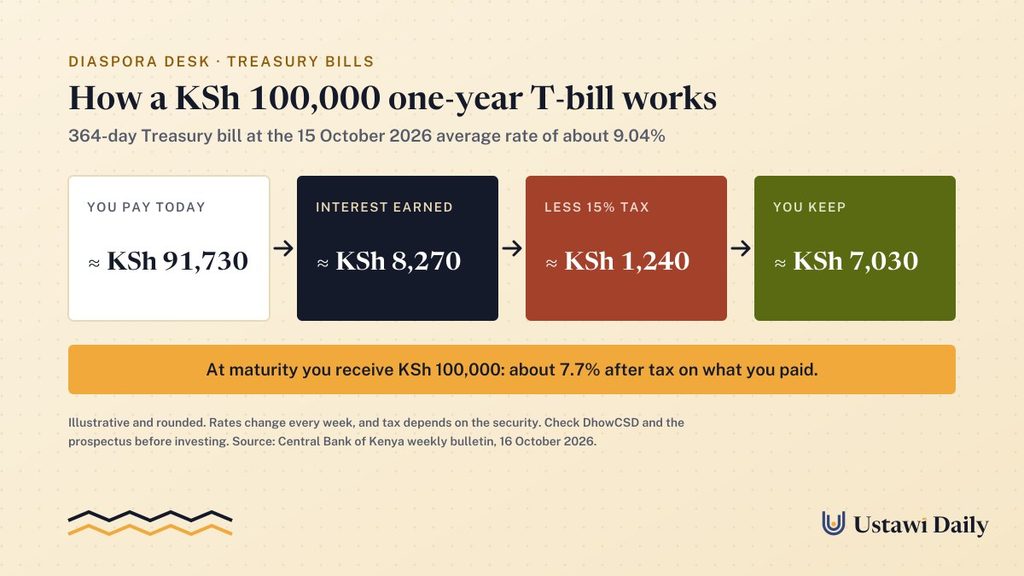
At the auction of 15 October 2026, the 364-day T-bill averaged about 9.04%. Here is roughly what a KSh 100,000 (face value) one-year bill at that rate would look like:
| Item | Amount |
|---|---|
| You pay (purchase price) | About KSh 91,730 |
| You receive at maturity (face value) | KSh 100,000 |
| Interest earned (the discount) | About KSh 8,270 |
| Less withholding tax at 15% | About KSh 1,240 |
| Net interest | About KSh 7,030 (roughly 7.7% after tax on what you paid) |
Illustrative only. Actual prices depend on the rate at your auction, and figures are rounded.
For a bond, the maths is simpler. A bond with a 12% coupon pays KSh 6,000 every six months on KSh 100,000 invested, before tax. At a 15% withholding rate you would keep KSh 5,100 each time. This is an illustration, not a current offer; check each prospectus for the actual coupon and tax rate.
How much tax will you pay on Treasury bills in Kenya?
Interest on government securities is usually taxed at source through withholding tax, so the amount you receive is already net of tax. Commonly cited rates are:
- Treasury bills: 15%
- Treasury bonds: often 15% for bonds under 10 years and 10% for longer bonds
- Infrastructure bonds: historically exempt
Tax rules change, and your rate can depend on whether you count as a tax resident of Kenya. The prospectus for each security states its tax treatment, and the Kenya Revenue Authority (KRA) publishes current rates. If you also pay tax in the country where you live, ask a tax adviser how your Kenyan interest is treated there.
Treasury bills in Kenya:The risks to understand first
- Currency risk. Your returns are in Kenyan shillings. If the shilling weakens against the currency you earn in, the value of your investment falls in that currency, even though you earn interest. If you plan to spend the money in Kenya, for building, land or family support, this matters less.
- Liquidity. T-bills mature quickly, but bonds tie up money for years. You can sell many bonds on the Nairobi Securities Exchange before maturity, or use the CBK’s rediscounting facility, but the price you get may be lower than you paid.
- Interest-rate changes. If rates rise after you buy a bond, its market price usually falls. This matters only if you sell before maturity.
- Government credit risk. Kenyan government securities are generally considered the safest shilling investments, but no investment is entirely without risk.
- Scams. Use only the official DhowCSD portal and app. Never share your password, PIN or one-time code with anyone, and be wary of “agents” offering to invest on your behalf.
Treasury bills in Kenya vs bonds vs money market funds
| Feature | Treasury bills | Treasury bonds | Money market fund |
|---|---|---|---|
| Term | 3, 6 or 12 months | Typically 2 to 20+ years | No fixed term |
| Minimum | KSh 50,000 (face value) | KSh 50,000 (face value) | Often much lower |
| Access to money | At maturity | At maturity, or sell on the market | Usually within a few days |
| Who you deal with | The CBK directly | The CBK directly | A licensed fund manager |
| Best for | Short-term saving at a fixed rate | Long-term, regular income | Flexibility and smaller amounts |
Many diaspora investors combine them: a money market fund for flexible savings and emergencies, T-bills for money needed within a year, and bonds for long-term income.
Frequently asked questions
Can I buy Treasury bills in Kenya from abroad?
Yes. Open a DhowCSD account with the Central Bank of Kenya online or through its app, link a Kenyan bank account in your name, and place bids from anywhere in the world.
What is the minimum investment in Treasury bills in Kenya?
The CBK’s minimum is KSh 50,000 face value for non-competitive bids, in multiples of KSh 50,000. Competitive bids start at KSh 2 million.
Do I need to visit Kenya to open a DhowCSD account?
No. Registration is online. You do need a Kenyan bank account, which many banks allow diaspora customers to open remotely.
Can I pay from my foreign bank account?
Payment for securities is made in Kenyan shillings through a Kenyan bank. Send money to your Kenyan account first, then pay from it before the settlement deadline.
Can I move my returns back abroad?
Yes. Kenya does not have exchange controls, so you can transfer your money out of the country, subject to your bank’s normal requirements, fees and exchange rate.
Are Treasury bills safer than a money market fund?
T-bills are a direct loan to the government, generally considered the lowest-risk shilling investment. Money market funds invest in a mix of assets, including government securities, through a fund manager, and offer more flexibility. Both are regulated, and both carry some risk.
Read next
- Sending money to Kenya: how to cut remittance costs
- Money market funds in Kenya explained
- More guides on our Diaspora Desk
- How to open a bank account in Kenya from abroad
- How to invest in Kenya from abroad: the complete guide
Investing from abroad and have a question? Email editor@ustawidaily.com with the subject “Question,” and we’ll answer the most common ones in future guides.
Sources: Central Bank of Kenya guidance on Treasury bills, bonds and the DhowCSD platform; CBK weekly bulletin of 16 October 2026; Kenya Revenue Authority withholding tax guidance. Last reviewed: October 2026.
This article is general information, not financial or tax advice. Rates, minimums and tax rules change. Check current details with the Central Bank of Kenya and the prospectus before investing, and consider speaking to a licensed financial adviser.