SACCO Dividend Rates in Kenya 2026: Top-Paying SACCOs and How to Choose One
FINANCE · BANKING & SACCOS
Which SACCOs paid the most in 2026, and what do those headline numbers really mean for your money? Here are the latest SACCO dividend rates in Kenya, why the deposit rate matters more than the dividend, and how to choose a safe, well-run SACCO.
SACCOs (savings and credit co-operative societies) are one of the most popular ways to save and borrow in Kenya. Members pool their savings, the SACCO lends to members, and the surplus is shared out each year as dividends on share capital and interest on deposits.
Every year, after SACCOs hold their annual general meetings, members and would-be members compare the rates. This guide sets out the SACCO dividend rates in Kenya declared in 2026, for the financial year ended 31 December 2025, and explains how to read them properly.
Key takeaways
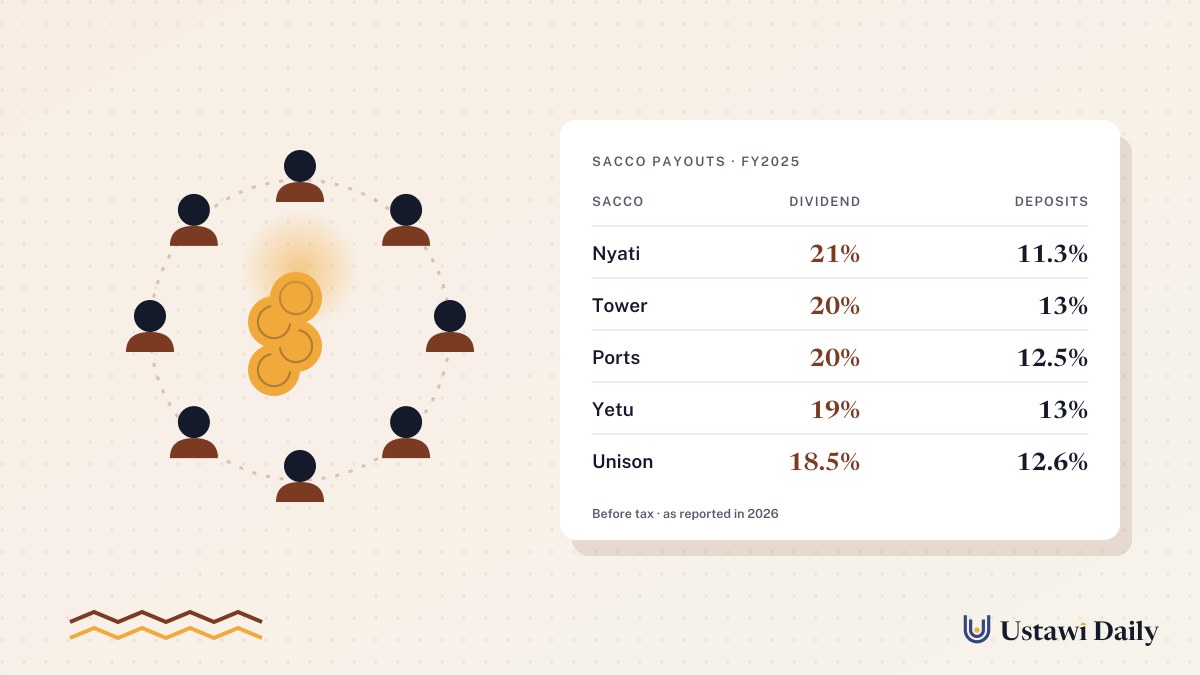
- The highest declared dividends on share capital in 2026 included Nyati (21%), Tower (20%), Ports (20%) and Yetu (19%), for the 2025 financial year.
- For most members, the interest on deposits matters more than the dividend, because deposits are usually far larger than share capital. Top SACCOs paid about 11% to 13% on deposits.
- SACCO dividends and interest are taxed at source, typically at 5% withholding tax, compared with 15% on money market funds and Treasury bills.
- Deposit-taking SACCO assets passed KSh 1 trillion in 2025, according to the regulator, SASRA.
- SACCO deposits are not covered by deposit insurance, and deposits are usually locked in until you leave. Choose carefully and check that the SACCO is licensed.
SACCO dividend rates in Kenya: the 2026 payouts
The table below shows rates declared by selected SACCOs for the financial year ended 31 December 2025, as compiled from SACCO announcements and reported in early 2026. Rates are before tax.
| SACCO | Dividend on share capital | Interest on deposits |
|---|---|---|
| Nyati DT SACCO | 21% | 11.3% |
| Tower SACCO | 20% | 13% |
| Ports DT SACCO | 20% | 12.5% |
| Yetu DT SACCO | 19% | 13% |
| Unison SACCO | 18.5% | 12.6% |
| Nation DT SACCO | 18% | 10% |
| Ollin SACCO | 17.5% | 12.2% |
| Kenya National Police DT SACCO | 17% | 11% |
| Hazina SACCO | 17% | 10.75% |
| Cosmopolitan SACCO | 16.5% | 12.05% |
| Winas SACCO | 16.5% | 12.5% |
| Stima DT SACCO | 16% | 11% |
| Nawiri SACCO | 15% | 15% |
| Mwalimu National SACCO | 13% | 10% |
Compiled from SACCO announcements as reported in 2026. Some reports differ slightly for a few SACCOs, so confirm the declared rates in your SACCO’s AGM circular or with the SACCO directly. This is not a ranking of safety or quality.
Why the deposit rate matters more than the dividend
This is the most misunderstood point about SACCO dividend rates in Kenya. Your money in a SACCO usually sits in two places:
- Share capital: a fixed, often small amount you buy to become a member. It earns the dividend. It is not withdrawable, though it can usually be transferred to another member.
- Deposits: your regular monthly savings, which usually make up most of your balance. They earn interest on deposits, are used to work out how much you can borrow, and are generally refunded only when you leave the SACCO.
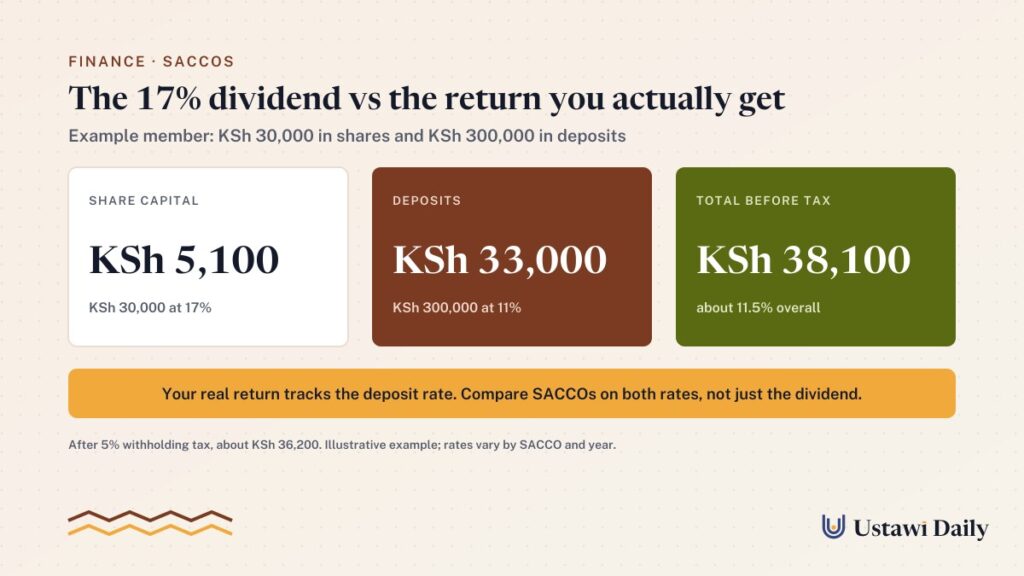
An example: say you hold KSh 30,000 in share capital at a 17% dividend and KSh 300,000 in deposits at 11%.
| Balance | Rate | Earnings before tax | |
|---|---|---|---|
| Share capital | KSh 30,000 | 17% | KSh 5,100 |
| Deposits | KSh 300,000 | 11% | KSh 33,000 |
| Total | KSh 330,000 | about 11.5% overall | KSh 38,100 |
After 5% withholding tax, you would keep about KSh 36,200. Notice that the overall return is close to the deposit rate, not the eye-catching 17% dividend. When comparing SACCOs, look at both rates, and weigh the deposit rate more heavily.
How SACCOs compare with other savings options
| Option | Typical return (2026) | Tax | Access to money |
|---|---|---|---|
| Top SACCO deposits | About 11% to 13% a year | Usually 5% | Locked in until you leave; can borrow against them |
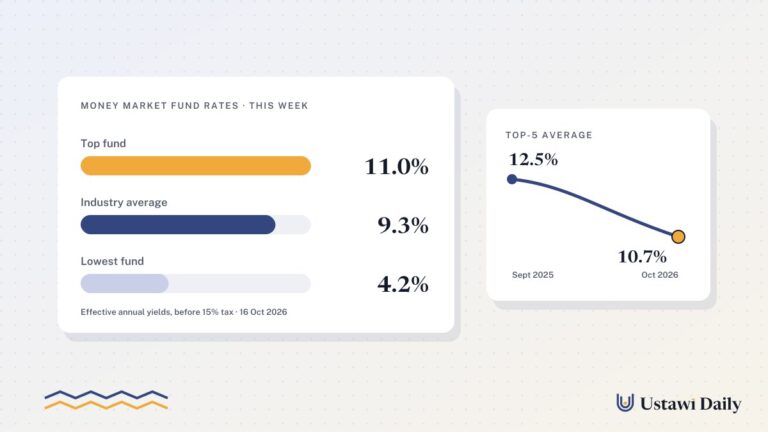
| Money market funds | Average about 9.3% | 15% | Usually 1 to 3 working days |
| 364-day Treasury bill | About 9% | 15% | At maturity |
SACCO deposits can look the most attractive on paper, especially after tax, and they come with access to loans, often three to four times your deposits. But you give up easy access to your money, and you take on the risk of the SACCO itself. Many savers combine them: a SACCO for long-term savings and borrowing, and a money market fund for money they may need quickly.
Kenya’s SACCO sector in numbers
According to the Sacco Societies Regulatory Authority (SASRA)‘s 2025 supervision report, released on 28 September 2026:
- Assets of deposit-taking SACCOs reached about KSh 1.07 trillion, up 13.17%, crossing a trillion shillings for the first time.
- All 357 regulated SACCOs together held about KSh 1.21 trillion.
- Membership of regulated SACCOs rose to 7.87 million, from 7.39 million in 2024.
- Mwalimu National SACCO remained the largest, with assets of about KSh 76 billion.
- 176 SACCOs were licensed to take deposits for 2026.
How to choose a safe, well-run SACCO
- Check the licence. Confirm on SASRA’s website that the SACCO is licensed for the current year. SASRA warns the public against dealing with unlicensed SACCOs.
- Look at the track record, not one good year. Steady rates over several years are a better sign than a single high payout.
- Read the annual report. Look at loan defaults, how much the SACCO depends on a single employer, and whether its auditors raised concerns.
- Check for unremitted deductions. SASRA has reported that some employers deducted SACCO contributions from salaries without passing them on. If your employer pays your contributions, confirm they reach your account.
- Understand the rules on leaving. Ask how long it takes to get your deposits back if you exit, and what notice is required.
- Remember the risks. SACCO deposits are not insured by the Kenya Deposit Insurance Corporation. A deposit guarantee fund has been proposed in the Sacco Societies (Amendment) Bill, 2025, but members should not rely on it until it is law. The 2025 scandal at KUSCCO, a co-operative union where many SACCOs had placed money, left several of them facing losses and shows why governance matters.
Can Kenyans abroad join a SACCO?
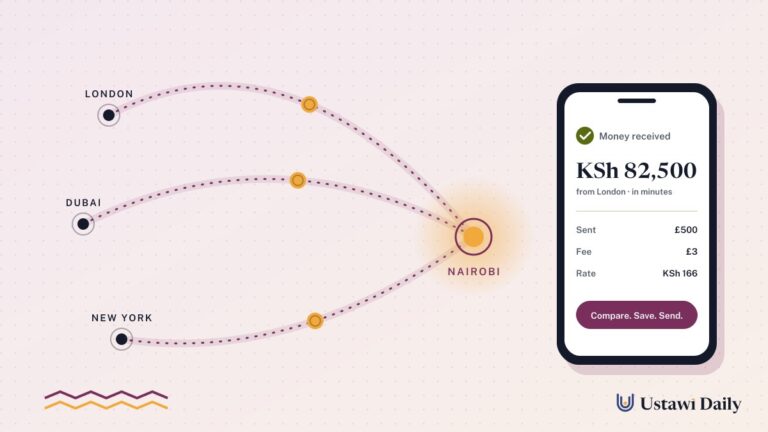
Yes, many can. Some SACCOs have open membership or dedicated diaspora products, while others are limited to people in a particular employer, profession or region. Ask the SACCO directly whether you qualify, how to register remotely and how to make monthly contributions from abroad.
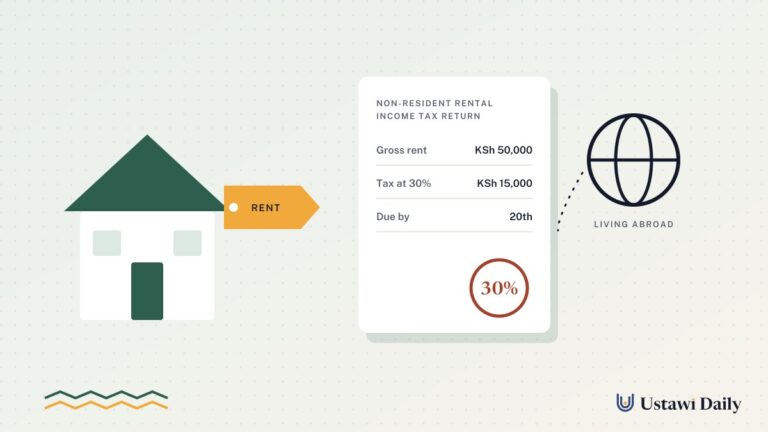
You will usually need a Kenyan ID or passport, a KRA PIN and a way to pay from abroad. A Kenyan bank account makes regular contributions much easier: see our guide on opening a bank account in Kenya from abroad. Note that tax on SACCO income can differ for non-residents, so check your position.
Frequently asked questions
Which SACCO paid the highest dividend in 2026?
Among SACCO dividend rates in Kenya reported for the 2025 financial year, Nyati DT SACCO declared the highest dividend on share capital, at 21%, followed by Tower and Ports at 20%.
What is the difference between a SACCO dividend and interest on deposits?
The dividend is paid on your share capital, which is usually small and not withdrawable. Interest is paid on your deposits, which usually make up most of your savings. For most members, the deposit rate drives most of their return.
Are SACCO dividends taxed in Kenya?
Yes. SACCO dividends and interest on deposits are taxed at source through withholding tax, typically at 5% for members. The SACCO deducts it before paying you.
Is my money safe in a SACCO?
Licensed SACCOs are supervised by SASRA, but SACCO deposits are not covered by deposit insurance. Choose a well-run, licensed SACCO with a long track record, and avoid putting all your savings in one place.
Are SACCOs better than money market funds?
They serve different purposes. SACCOs often pay more and let you borrow, but your deposits are locked in. Money market funds pay less but let you withdraw within days. Many savers use both.
Read next
- Money market fund rates in Kenya this week
- How to invest in Treasury bills and bonds in Kenya
- Money market funds in Kenya explained
- How to invest in Kenya from abroad: the complete guide
Know a SACCO rate we should add? Email editor@ustawidaily.com with the SACCO’s official AGM circular, and we’ll verify and include it.
Sources: Sacco Societies Regulatory Authority (SASRA), SACCO Supervision Annual Report 2025 (released 28 September 2026) and 2026 licensing notice; SACCO dividend and interest announcements for the year ended 31 December 2025, as compiled and reported in 2026; Kenya Revenue Authority withholding tax rates. Last reviewed: 28 October 2026.
This article is general information, not financial advice. Ustawi Daily has no commercial relationship with any SACCO mentioned. Past dividends do not guarantee future payouts. Confirm current rates and terms with the SACCO before joining.