Money Market Funds in Kenya Explained (2026): How They Work, What You Really Earn and How to Choose One
FINANCE · PERSONAL MONEY
Money market funds in Kenya have become the go-to home for savings, from emergency funds to diaspora remittances. Here is how they actually work, what you really take home after fees and tax, how safe they are, and how to choose one wisely.
If your savings are sitting in an ordinary bank account in Kenya, there is a good chance they are earning very little. That is why a fast-growing number of Kenyans, at home and abroad, have moved their cash into money market funds (MMFs): low-risk investment funds that typically pay far more than a savings account while letting you withdraw within a few days.
But not all funds are equal, headline rates can mislead, and “low risk” does not mean “no risk.” This guide explains everything you need to know before you invest.
Key takeaways
- A money market fund pools money from many investors and invests it in short-term, low-risk assets such as Treasury bills, bank fixed deposits and commercial paper.
- Kenyan MMFs are regulated by the Capital Markets Authority (CMA), and your money is held by an independent custodian, separate from the fund manager.
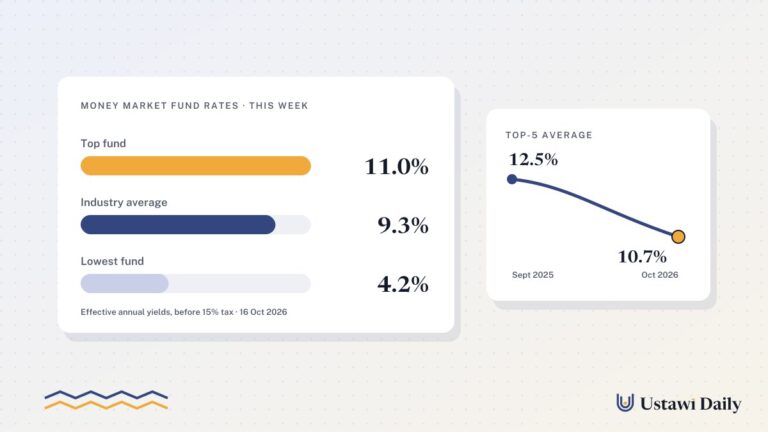
- In mid-October 2026, the average shilling MMF paid about 9.3% a year after fees but before tax. The top funds paid about 11%, while some, often linked to banks or mobile platforms, paid as little as 4% to 6%. Rates change daily.
- Interest is subject to a 15% withholding tax, deducted automatically, so what you keep is noticeably less than the headline rate.
- Low risk is not no risk. MMFs are not bank deposits and are not covered by deposit insurance.
- Choose a fund on consistent net returns, fees, manager strength, what it invests in and how fast you can withdraw, not just the highest rate today.
What is a money market fund?
A money market fund is a type of collective investment scheme, often called a unit trust. Instead of investing alone, you join thousands of other investors in one large pool of money. A CMA-licensed fund manager invests that pool in short-term, interest-earning assets, mainly Treasury bills, fixed deposits and high-quality commercial paper (short-term company borrowing).
Because the pool is large, the fund can access better rates than most individual savers could get on their own. The interest earned is shared among investors in proportion to how much each has invested.
How big are money market funds in Kenya?
Very big, and still growing. According to the Capital Markets Authority’s report for the quarter to June 2026, total assets in Kenya’s collective investment schemes reached KSh 948.7 billion, up from KSh 851.7 billion in March. Money market funds held KSh 459.9 billion, about 48.5% of the total, across 59 funds.
Money market funds are still the largest category, but their share has slipped below half, as faster growth has gone to riskier “special funds” (see below).
How do money market fund returns work?
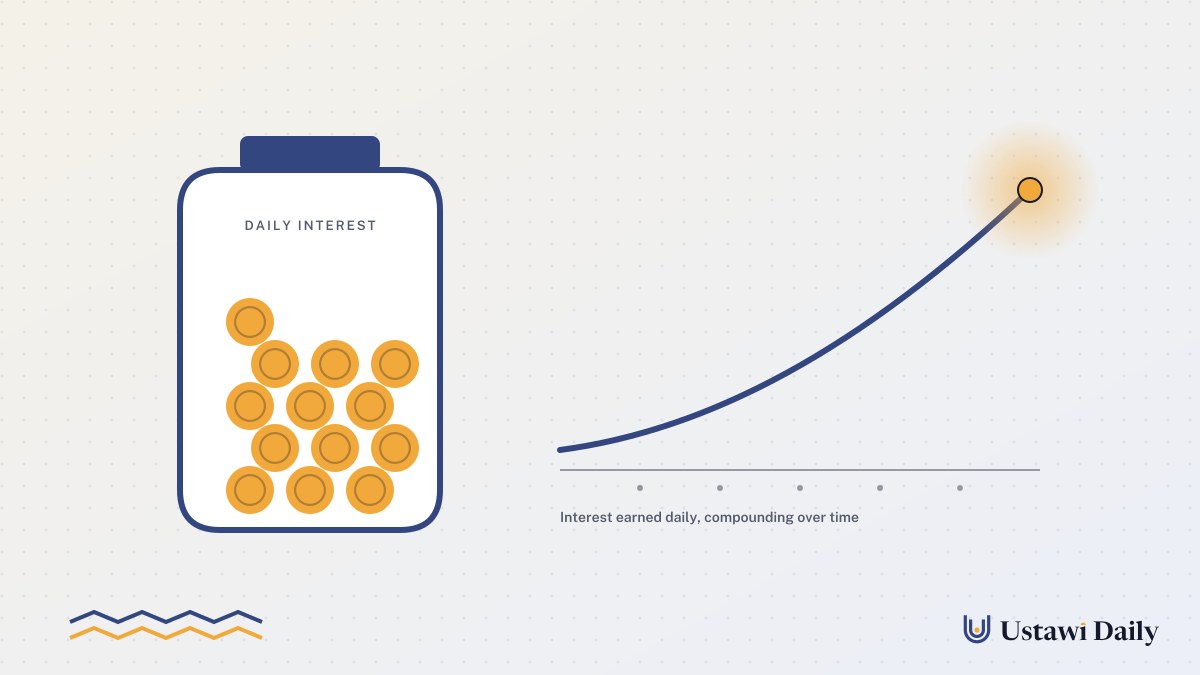
Interest is earned daily. Most Kenyan MMFs calculate interest every day and credit it to your account, usually monthly, so your interest also earns interest (compounding).
Rates are not fixed. An MMF’s yield rises and falls with the interest rates on the assets it holds. When Treasury bill rates fall, for example after the Central Bank of Kenya lowers its benchmark rate, MMF yields usually follow.
What are funds paying now? In mid-October 2026, the average return across 26 shilling MMFs was about 9.3% a year after fees but before tax, according to Business Daily. In a weekly table of 34 funds, the highest paid about 11.0% and the lowest about 4.2%. Rates change daily: for this week’s figures, see our page on money market fund rates in Kenya, which we update weekly.
What you really earn: fees and tax
Funds don’t all quote their rates the same way. Two deductions matter.
1. Management fees. The fund manager charges an annual fee, often around 2% of assets. Many funds quote their yield after this fee but before tax. Check how your fund quotes its rate before comparing.
2. Withholding tax of 15%. Interest from MMFs is taxed at 15%, deducted at source by the fund. For most individual savers this is a final tax, so you don’t declare it again.
A simple example (approximate, for illustration):
- You invest KSh 100,000 in a fund quoting 10% a year after fees.
- Over a year you earn about KSh 10,000 in interest.
- Withholding tax of 15% takes about KSh 1,500.
- You keep about KSh 8,500, roughly 8.5% in real terms.
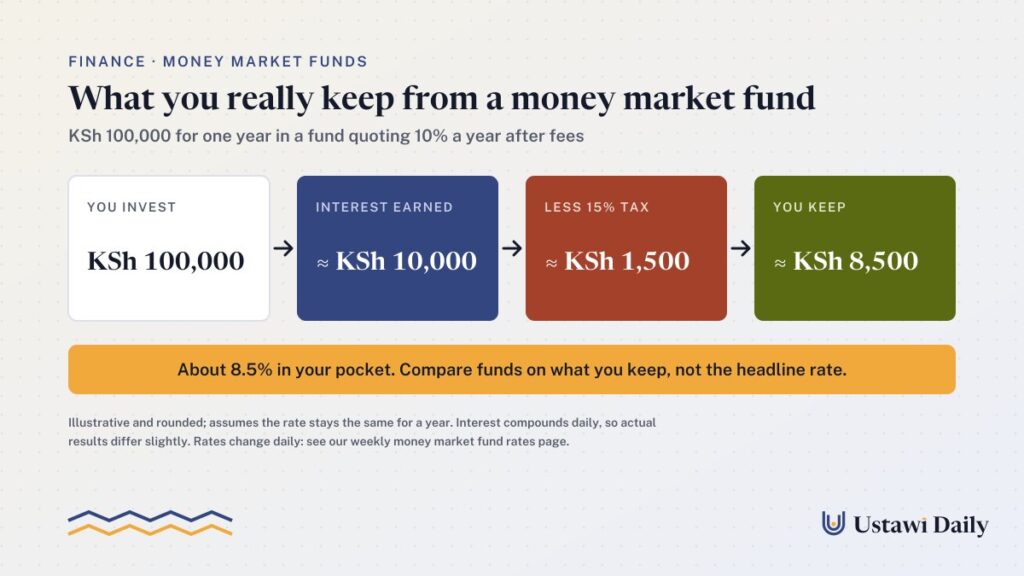
That is still far more than most savings accounts. But compare funds on what you keep, not the headline figure.
How MMFs compare with other ways to save
| Option | Typical returns | Access to your money | Risk level | Regulated by |
|---|---|---|---|---|
| Bank savings account | Low | Instant | Very low; deposit insurance up to a limit | Central Bank of Kenya |
| Fixed deposit | Higher than savings; fixed for the term | Locked until the term ends | Very low; deposit insurance up to a limit | Central Bank of Kenya |
| Money market fund | Average about 9.3% a year before tax (mid-October 2026) | Usually within about 2 working days | Low; no deposit insurance | Capital Markets Authority |
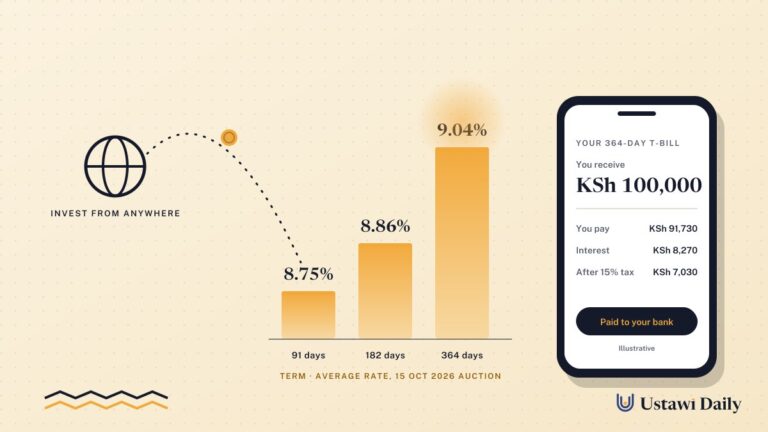
| Treasury bills | Set at weekly auctions (364-day bill: about 9.04%, 15 October 2026) | Held to maturity (91, 182 or 364 days) | Very low (government-backed) | Central Bank of Kenya |
| SACCO deposits | Annual dividends or interest; vary by SACCO | Depends on SACCO rules; often tied to loans | Varies by SACCO | SASRA (deposit-taking SACCOs) |
In short: MMFs suit money you may need within weeks or months, such as an emergency fund or savings for an upcoming purchase. For money you won’t touch for a year or more, Treasury bills and bonds or a well-run SACCO may also deserve a place.
Are money market funds safe?
MMFs are among the lowest-risk investments available, but understand exactly what protects you, and what doesn’t.
What protects you:
- Regulation: every fund must be licensed and overseen by the CMA.
- Separation of roles: each unit trust must have a CMA-approved fund manager, custodian, trustee and auditor, so no single party controls your money. The custodian (usually a bank) holds the assets, and the trustee checks the manager follows the rules.
- Conservative assets: mostly government securities and bank deposits.
What doesn’t:
- No deposit insurance. An MMF is an investment, not a bank deposit, so it is not covered by Kenya’s deposit insurance scheme.
- Returns can fall. If interest rates drop, so will your yield.
- Credit risk. Funds that hold more commercial paper (company debt) earn more but carry more risk if a borrower defaults.
- Manager risk. Smaller or newer managers may be less resilient in a market shock.
Money market funds vs “special funds”: know the difference
Kenya’s fastest-growing category is special funds, which held about 26.6% of all unit trust assets by June 2026, up from 23.9% in March, according to the CMA. They often advertise higher returns than MMFs, but they are not money market funds. They may invest in longer-term, riskier or offshore assets, can carry different withdrawal terms, and returns are less predictable.
If a fund promises unusually high returns, check its category and read its documents before investing. Higher return almost always means higher risk.
How to choose a money market fund: 8 things to check
- CMA licence: confirm the fund manager appears on the Capital Markets Authority’s list of licensed fund managers.
- Net return, over time: compare 3 to 6 months of returns, not one day’s rate. Consistency matters more than topping a weekly ranking.
- Fees: check the annual management fee and whether the quoted yield is before or after fees.
- What it invests in: read the fund’s fact sheet. More government securities means lower risk; more commercial paper means higher risk.
- Manager strength and fund size: larger, established managers and funds tend to be more resilient, though size alone is no guarantee.
- Withdrawal speed: many funds pay out within about two working days. Confirm before you invest, especially for emergency savings.
- Minimum investment and access: minimums vary from fund to fund. Check the minimum, and whether you can deposit and withdraw by app and M-Pesa.
- Currency: some managers offer US dollar MMFs alongside shilling funds. Dollar funds pay lower rates but protect against shilling depreciation, a useful option for diaspora investors.
How to invest in a money market fund from abroad
Kenyans in the diaspora can open and fund most MMFs remotely. Typical requirements are:
- A valid Kenyan national ID or passport
- A KRA PIN
- Proof of address (Kenyan or foreign)
- A passport photo
- A source-of-funds declaration
Accounts are usually opened online through the fund manager’s website or app. From abroad you can fund them by bank transfer or through remittance services that pay into M-Pesa. Compare costs first: see our guide on how to send money to Kenya for less. The 15% withholding tax applies to both residents and non-residents.
A practical tip for diaspora savers: an MMF is a sensible place to hold money while you prepare a bigger investment back home. If you’re saving to buy land, for example, your funds can earn interest while you complete the checks in our guide on how to verify a title deed in Kenya from abroad.
How to open an account, step by step
- Shortlist two or three CMA-licensed funds using the checklist above.
- Register on the fund manager’s website or app with your ID or passport, KRA PIN and contact details.
- Read the fund’s fact sheet and terms, especially fees and withdrawal times.
- Make your first deposit by M-Pesa paybill or bank transfer.
- Track your statements monthly and review performance every few months.
Frequently asked questions
Are money market funds in Kenya safe?
They are among the lowest-risk investments available because they are CMA-regulated, hold conservative assets and keep your money with an independent custodian. But they are not risk-free and are not covered by deposit insurance.
How much can I earn from a money market fund in Kenya?
In mid-October 2026, the average shilling MMF paid about 9.3% a year before tax, with the top funds at about 11% and some as low as 4% to 6%. After the 15% withholding tax, you keep less. Rates change daily, so check current figures.
Is money market fund interest taxed in Kenya?
Yes. A 15% withholding tax is deducted from interest at source. For most individuals this is a final tax.
How fast can I withdraw from a money market fund?
Many funds process withdrawals within about two working days. Check your fund’s terms before investing.
Can I invest in a Kenyan money market fund from abroad?
Yes. Most fund managers allow online registration with a Kenyan ID or passport and KRA PIN, and funding by bank transfer or remittance services.
What is the difference between a money market fund and a special fund?
MMFs invest in short-term, low-risk assets such as Treasury bills and fixed deposits. Special funds can invest in longer-term or riskier assets and usually carry more risk and different withdrawal terms.
Read next
- Money market fund rates in Kenya this week
- How to invest in Treasury bills and bonds in Kenya from abroad
- How to verify a title deed in Kenya from abroad: a step-by-step guide
- More practical guides on our Diaspora Desk
- SACCO dividend rates in Kenya
- How to invest in Kenya from abroad: the complete guide
Have a question about saving or investing back home? Send it to our Diaspora Desk at editor@ustawidaily.com with the subject “Question.” We answer the most common questions in future guides. Need personalised help? Use the subject “Expert help” and we’ll point you to trusted, qualified professionals.
Sources: Capital Markets Authority, Collective Investment Schemes Quarterly Report for the period ended 30 June 2026; Business Daily, average MMF returns, 18 October 2026; Cytonn weekly MMF yield table, 16 October 2026; Central Bank of Kenya Treasury bill auction results. Last reviewed: 20 October 2026.
This article is general information, not financial advice. Investment returns are not guaranteed and past performance does not predict future results. Rates quoted are approximate and change daily. Confirm current details with the fund manager before investing.