How to Buy Shares on the NSE From Abroad (2026): A Step-by-Step Diaspora Guide
DIASPORA DESK · FINANCE
You can own a piece of Kenya’s biggest companies without leaving London, Dallas or Dubai. Here is how to buy shares on the NSE from abroad, step by step: the account you need, what it costs, how you are taxed, and the risks to understand before you start.
Shares in companies such as Safaricom, KCB Group, Equity Group and East African Breweries are listed on the Nairobi Securities Exchange (NSE). Owning shares gives you two possible sources of return: dividends, which are a share of company profits paid out to shareholders, and capital gains, if the share price rises.
For Kenyans abroad, shares are one of the simplest ways to invest back home. There is no land to inspect, no tenant to manage, and you can start with a modest amount. This guide explains how to buy shares on the NSE from abroad, in plain language.
Key takeaways
- To buy NSE shares you need a CDS account, opened through a stockbroker licensed by the Capital Markets Authority (CMA). You cannot buy directly from the exchange.
- Most brokers, and several investing apps, let you open an account remotely with your passport or ID, KRA PIN and proof of address.
- Gains on NSE-listed shares are exempt from capital gains tax, and transfers of listed shares are exempt from stamp duty.
- Dividends are taxed at source: 5% for qualifying residents and 15% for non-residents, which is the rate most Kenyans living abroad pay.
- Your returns are in Kenya shillings, so currency movements affect what your shares are worth abroad.
- Shares can fall as well as rise. Invest money you can leave for several years.
How the NSE works, in brief
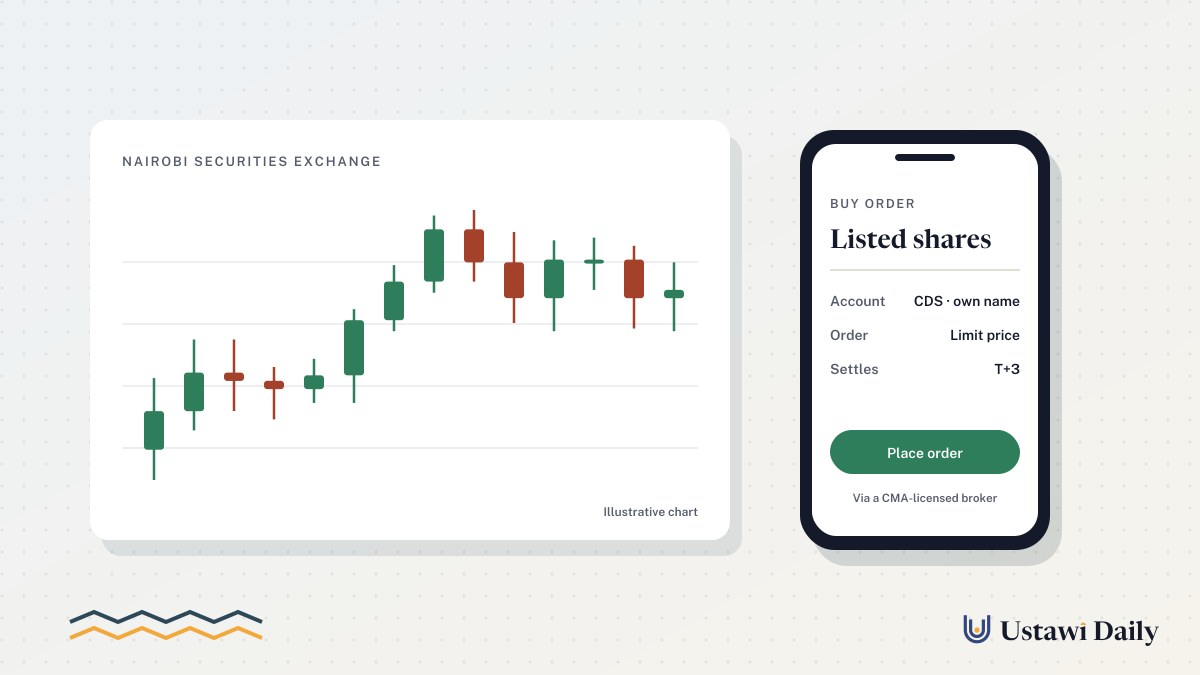
The NSE is where shares of listed Kenyan companies are bought and sold. The Capital Markets Authority regulates the market. Your shares are not held on paper: they are recorded electronically in your name at the Central Depository and Settlement Corporation (CDSC), in what is called a CDS account.
You place orders through a licensed stockbroker (or an app that works with one), and the broker executes them on the exchange. Trades usually settle into your CDS account within three working days.
Note: the CDS account for shares is different from the CDS account you use for Treasury bills and bonds, which is opened with the Central Bank through DhowCSD. If you want both, you need both.
What you need to buy shares on the NSE from abroad
- A Kenyan passport or national ID
- A KRA PIN, which you can register for online through KRA’s iTax portal if you don’t have one
- Proof of your address abroad, such as a recent utility bill or bank statement
- A passport-size photo and a signed CDS application
- A bank account for funding your account and receiving dividends and sale proceeds. A Kenyan account is usually the simplest. See our guide on opening a bank account in Kenya from abroad.
- A source-of-funds declaration, which some brokers ask for
When you open the account, you declare your investor category, for example local individual or foreign investor. This affects how your dividends are taxed, so answer accurately.
How to buy shares on the NSE from abroad: step by step
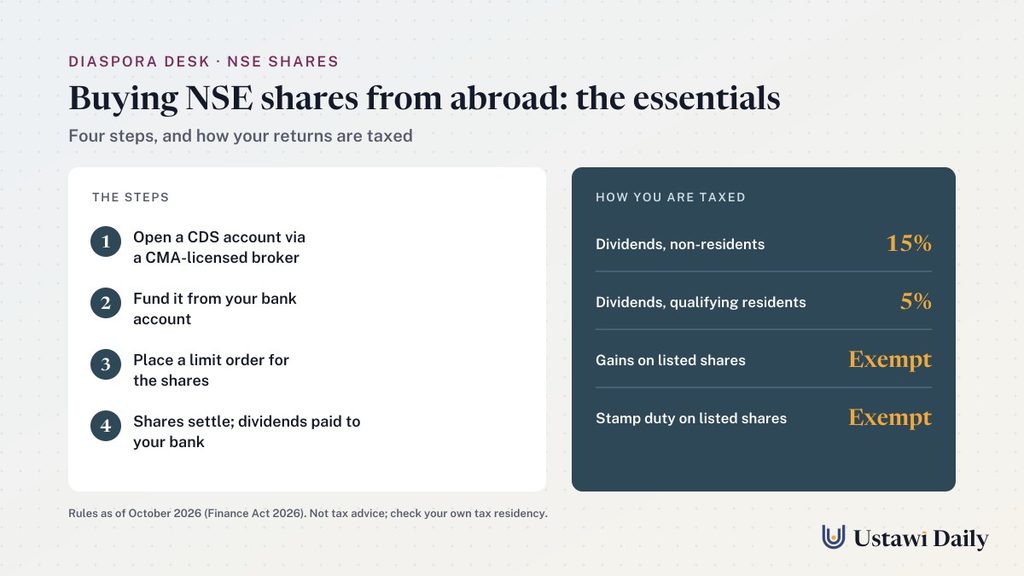
- Choose a CMA-licensed stockbroker or a regulated app. Confirm the broker is on the CMA’s list of licensees. Several apps now offer paperless account opening by working with licensed brokers; check which broker holds your account and that your CDS account is in your own name.
- Open your CDS account. Fill in the broker’s application, upload your documents and complete any identity check. Approval typically takes a few working days.
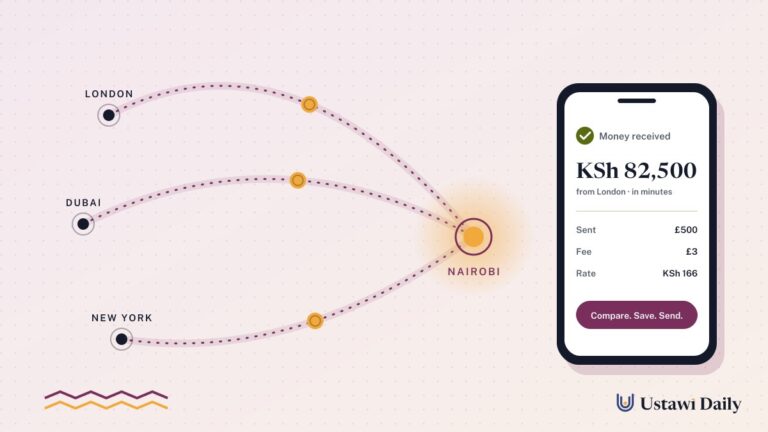
- Fund your account. Send money from your Kenyan bank account, or by international transfer, as your broker instructs. Compare transfer costs first: see our guide on how to send money to Kenya for less.
- Place your order. Choose the company, the number of shares and, ideally, a limit price: the most you are willing to pay per share.
- Confirm the trade. When your order is matched, you receive a contract note, and the shares settle into your CDS account.
- Receive dividends. Companies pay dividends, after withholding tax, to the bank account linked to your CDS account.
What it costs
- Opening a CDS account is free or low-cost with most brokers.
- Trading costs: each purchase or sale carries a broker’s commission plus statutory levies. Together, these often come to roughly 2% of the value of each trade for retail investors. Fees vary by broker and trade size, so check the broker’s fee schedule.
- Transfer costs when sending money to and from Kenya, including the exchange-rate margin.
Because each trade costs money, frequent buying and selling eats into returns. Most individual investors do better buying sound companies and holding them for years.
How you are taxed
| Income | Residents | Non-residents |
|---|---|---|
| Dividends | 5% withholding tax on qualifying dividends | 15% withholding tax (final) |
| Gains when you sell listed shares | Exempt from capital gains tax | Exempt from capital gains tax |
| Stamp duty on transfers of listed shares | Exempt | Exempt |
Whether you count as a resident or non-resident depends on Kenya’s tax residency rules, mainly how much time you spend in Kenya, not on citizenship. Most Kenyans living abroad are non-residents for tax purposes.
The Finance Act 2026 removed the reduced 5% dividend rate that previously applied to citizens of other East African Community countries, from 1 July 2026. If you also pay tax where you live, ask a tax adviser how your Kenyan dividends are treated there, and whether a tax treaty applies.
The risks to understand first
- Share prices fall as well as rise. You can lose money, especially over short periods.
- Currency risk. Your shares and dividends are in shillings. If the shilling weakens against the currency you earn in, your investment is worth less in that currency.
- Liquidity. Shares in large companies trade every day, but many smaller companies trade rarely, which can make them hard to sell quickly at a fair price.
- Concentration. A handful of large companies dominate the NSE. Spreading your money across several companies and sectors reduces risk.
- Scams. Use only CMA-licensed brokers. Never send money to an individual who promises to “buy shares for you”, and be wary of guaranteed returns.
Shares, Treasury bills or a money market fund?
Shares suit money you can leave invested for five years or more, and can grow through dividends and rising prices. Treasury bills and bonds offer fixed returns from the government. A money market fund is better for savings you may need soon. Many diaspora investors combine all three.
Frequently asked questions
Can I buy shares on the NSE from abroad?
Yes. Open a CDS account through a CMA-licensed stockbroker or a regulated app, fund it, and place orders online from anywhere in the world.
Do I need a Kenyan bank account to buy shares on the NSE from abroad?
It is usually the simplest option for funding your account and receiving dividends, but some brokers accept international transfers. Check with your broker.
How much money do I need to start?
There is no large minimum: you can start with the price of the shares you want plus trading costs. Because costs take a bigger bite out of very small trades, investing a meaningful amount at a time is more efficient.
Do I pay capital gains tax on NSE shares?
No. Gains on shares listed on the NSE are exempt from Kenya’s capital gains tax. Dividends are taxed at source.
What tax do I pay on dividends if I live abroad?
Non-residents generally pay a final 15% withholding tax on Kenyan dividends. Qualifying residents pay 5%.
Read next
- How to invest in Treasury bills and bonds in Kenya from abroad
- How to open a bank account in Kenya from abroad
- Money market fund rates in Kenya this week
- How to invest in Kenya from abroad: the complete guide
Investing from abroad and have a question? Email editor@ustawidaily.com with the subject “Question,” and we’ll answer the most common ones in future guides.
Sources: Capital Markets Authority (licensed intermediaries); Nairobi Securities Exchange; Kenya Revenue Authority withholding tax rates; Finance Act, 2026; PwC Kenya tax summaries on capital gains on listed securities. Last reviewed: 28 October 2026.
This article is general information, not financial or tax advice. Ustawi Daily does not recommend any particular share or broker. Share prices can fall as well as rise. Consider speaking to a licensed financial adviser before investing.