The Real Cost of Buying Land in Kenya (2026): Stamp Duty, Legal Fees and Hidden Costs
PROPERTY · LAND & PLOTS
The price on the sign is never the full cost of buying land. Stamp duty, legal fees, valuation, searches and a string of smaller charges can add several percent to what you pay. Here is the real cost of buying land in Kenya, with worked examples, so you can budget properly and avoid nasty surprises.
First-time land buyers, at home and abroad, can be caught out: they save for the purchase price, then find they need tens or even hundreds of thousands of shillings more to complete the transfer. If, for example, the stamp duty cannot be paid, the transfer cannot be registered.
This guide breaks down every cost of buying land in Kenya: the government charges, the professional fees, and the hidden costs that are easy to forget. Where fees vary or are set case by case, we say so and give approximate ranges, so you can ask for exact quotes.
Key takeaways
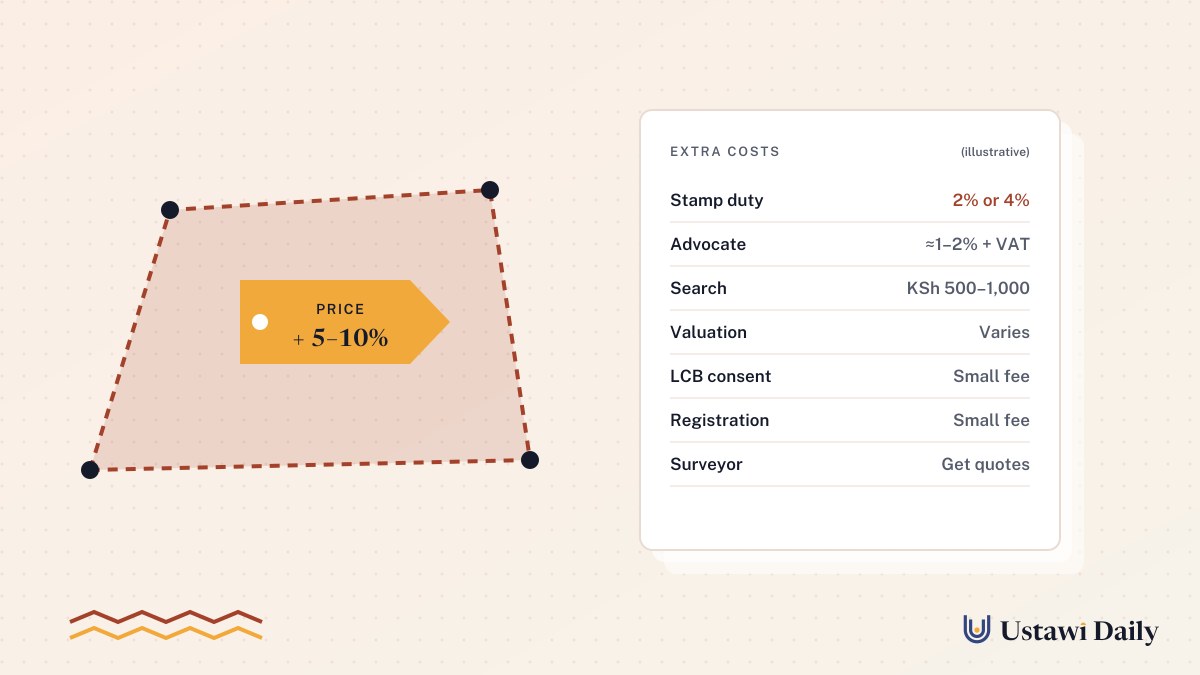
- Stamp duty is the biggest extra cost: 4% of the value for land in a city or municipality and 2% elsewhere, charged on the higher of the purchase price and the government valuation.
- Legal fees follow the Advocates (Remuneration) Order, typically about 1% to 2% of the value, plus 16% VAT, subject to minimum fees.
- Searches, valuation, registration and consents add smaller amounts, often totalling tens of thousands of shillings, though valuation fees can be higher on valuable property.
- As a rough guide, budget about 5% to 10% on top of the price, depending on location, value and the work needed.
- Check for unpaid land rates or rent before you buy: arrears can block the transfer.
The cost of buying land in Kenya: every charge explained
| Cost | Typical amount | Usually paid by |
|---|---|---|
| Stamp duty | 4% (city or municipality) or 2% (elsewhere) of the higher of the price and the government valuation | Buyer |
| Advocate’s fees | About 1% to 2% of the value, plus 16% VAT, subject to minimum fees under the Advocates (Remuneration) Order | Each side pays its own advocate |
| Official land search | Roughly KSh 500 to KSh 1,000 per search | Buyer |
| Government valuation (for stamp duty) | Varies; ask your advocate | Buyer |
| Land Control Board consent (agricultural land) | A small fee, roughly KSh 1,000 to KSh 3,000; sources differ | Often shared or agreed in the sale agreement |
| Transfer registration | Usually a few thousand shillings or less | Buyer |
| Surveyor (confirming beacons and boundaries) | Varies by location and work; get quotes | Buyer |
| Rates and rent clearance | Any arrears must be cleared before transfer | Seller, normally |
| Agent’s commission (if an agent is used) | Commonly a few percent of the price | Usually the seller; confirm in writing |
| Capital gains tax | 15% of the seller’s gain | Seller |
Amounts are approximate and can change. Government fees are set by regulation and may be revised; confirm current figures with your advocate or on the Ministry of Lands’ platforms.
Stamp duty: the biggest extra cost
Stamp duty is a tax on the transfer of land, paid by the buyer before the transfer can be registered. The rate depends on where the land is:
- 4% for land within a city or municipality
- 2% for land outside these areas, such as most rural farmland
The important detail: stamp duty is charged on the higher of the agreed price and the government valuation. If you negotiate a low price, or the price written in the agreement is lower than the land’s value, you may still pay duty on the higher, valued figure. Never agree to understate the price on documents to save tax: it is illegal and can put your ownership at risk.
Your advocate can confirm which rate applies to your parcel. Stamp duty is increasingly assessed and paid online through the Ministry of Lands’ digital systems; ask for the official assessment and keep the payment receipt.
Legal fees
A qualified advocate should handle the sale agreement, searches, consents, stamp duty and registration. Advocates’ fees for conveyancing are guided by the Advocates (Remuneration) Order, which sets a scale based on the property’s value, with minimum fees. In practice, buyers typically pay about 1% to 2% of the value, plus 16% VAT on the fee.
Agree the fee and exactly what it covers in writing before work starts. Always use your own independent advocate, never one recommended by the seller.
Worked examples: the cost of buying land in Kenya
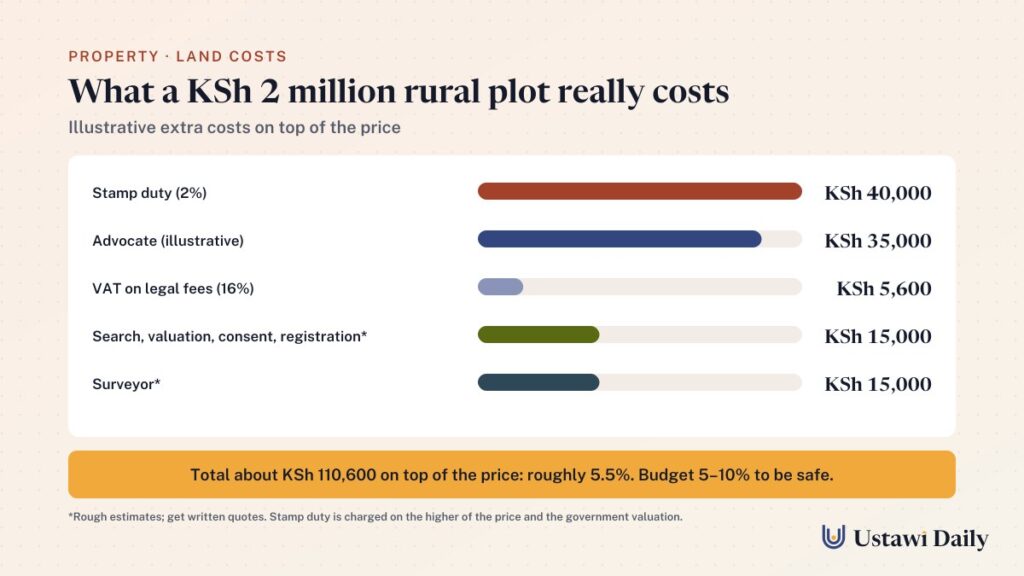
These examples show roughly what you might pay on top of the price. They are illustrations, not quotes: actual fees depend on your advocate, the land and the work required.
| Cost | Rural plot, KSh 2 million | Urban plot, KSh 5 million |
|---|---|---|
| Stamp duty | KSh 40,000 (2%) | KSh 200,000 (4%) |
| Advocate’s fees (illustrative) | KSh 35,000 | KSh 75,000 (1.5%) |
| VAT on fees (16%) | KSh 5,600 | KSh 12,000 |
| Search, valuation, consent, registration (estimate) | About KSh 15,000 | About KSh 15,000 |
| Surveyor (estimate) | About KSh 15,000 | About KSh 15,000 |
| Total extra costs | About KSh 110,600 (5.5%) | About KSh 317,000 (6.3%) |
Illustrative only. The estimates for searches, valuation, consents, registration and surveying are rough guides; get exact quotes. Stamp duty may be higher if the government valuation exceeds the price.
The hidden costs buyers forget
- Land rates and rent arrears. Unpaid county rates, or rent on leasehold land, must be cleared before transfer. Make sure the sale agreement says the seller pays any arrears.
- Subdivision. If you are buying part of a larger parcel, subdivision involves surveying, approvals and new titles. It takes time and money, so agree in writing who pays.
- Access, water and power. A cheap plot with no road, water or electricity can cost a great deal to make usable.
- Fencing and beacons. Securing the boundary soon after purchase protects you from encroachment.
- Your time and travel, or your representative’s, for site visits, Land Control Board meetings and signing.
- Delays. Transfers can take weeks or months. Factor in the cost of having money tied up.
Extra costs when you buy from abroad
- Power of Attorney. If someone signs for you in Kenya, the Power of Attorney must be stamped and registered. The Ministry of Lands lists a registration charge of KSh 1,000, plus stamp duty and, if signed abroad, notarisation and embassy authentication costs.
- Independent due diligence. Paying a firm or professionals to check the land on the ground costs money, but usually far less than losing your purchase to fraud.
- Transfer costs. Sending large sums home carries fees and exchange-rate margins. See our guide on how to send money to Kenya for less.
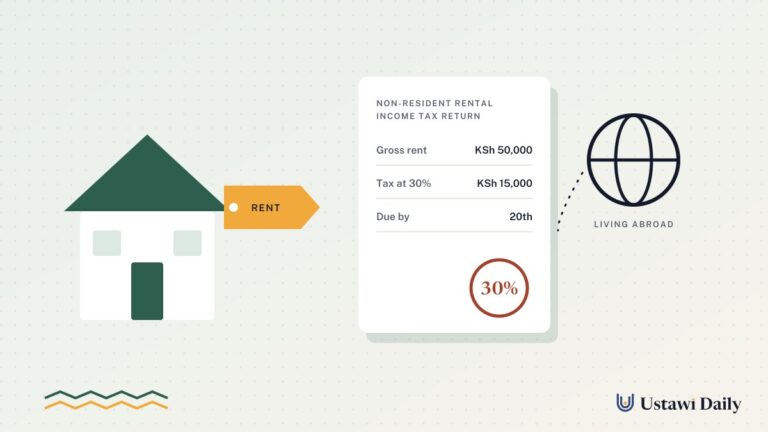
- Tax after you buy. If you rent the property out while living abroad, non-resident landlords now pay 30% of gross rent. See taxes for Kenyans abroad.
Ongoing costs after you buy
The cost of owning land does not end at transfer. Budget for:
- Land rates: an annual charge paid to the county government, which varies by county and by the value of the land.
- Land rent: an annual charge for leasehold land, paid to the national government.
- Security and upkeep: fencing, a caretaker or regular visits, especially if you live abroad.
- Tax if you earn from the land: for example, rental income tax if you build and let property.
Keep rates and rent paid up to date. Arrears grow over time and must be cleared before you can sell or transfer the land.
A checklist to take to your advocate
- Is the land in a city or municipality, so that 4% stamp duty applies, or elsewhere at 2%?
- What is your total fee, including VAT, and exactly what does it cover?
- Is Land Control Board consent needed, and who pays for it?
- Are there any rates or rent arrears, and does the sale agreement make the seller responsible?
- Do we need a surveyor to confirm the beacons or subdivide the land?
- What is the expected timeline from deposit to registration in my name?
How to keep the cost of buying land in Kenya down, safely
- Budget the extras before you agree a price. Add about 5% to 10% to the price for planning.
- Get written quotes from your advocate and surveyor, setting out exactly what is included.
- Check the land’s status early, with an official search and rates enquiries, before paying for anything else.
- Agree who pays what in the sale agreement, including arrears, consents and subdivision.
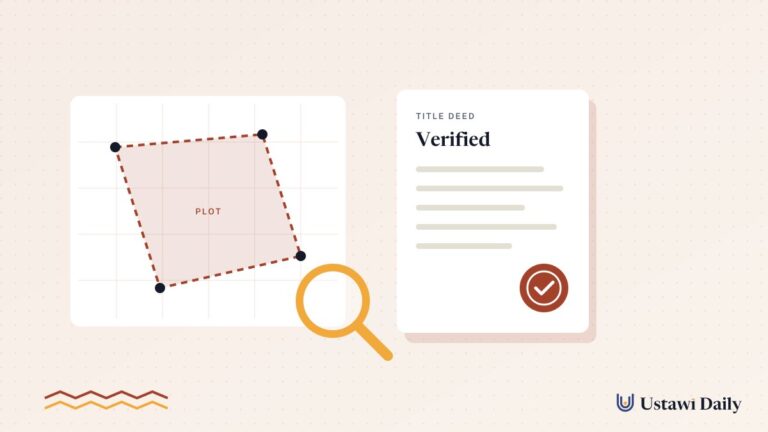
- Never cut corners on verification. The cheapest way to buy land is to buy it once, safely. Follow our guide on how to verify a title deed in Kenya.
Frequently asked questions
What is the total cost of buying land in Kenya?
On top of the price, budget roughly 5% to 10% for stamp duty, legal fees, VAT, searches, valuation, consents, registration and surveying. Stamp duty alone is 2% or 4% of the value.
How much is stamp duty on land in Kenya?
4% of the value for land in a city or municipality, and 2% elsewhere, charged on the higher of the price and the government valuation.
How much do lawyers charge to buy land in Kenya?
Fees follow the Advocates (Remuneration) Order, typically about 1% to 2% of the value, plus 16% VAT, with minimum fees. Agree the fee in writing first.
Who pays stamp duty in Kenya, the buyer or the seller?
The buyer pays stamp duty on a land transfer. The seller pays capital gains tax on any gain.
Is Land Control Board consent needed for all land?
No. It is generally needed for agricultural land under the Land Control Act. Without it, the transaction can be void, so your advocate should confirm whether it applies.
Read next
- How to verify a title deed in Kenya from abroad
- How to invest in Kenya from abroad: the complete guide
- More guides from our Property section
Buying land and have a question? Email editor@ustawidaily.com with the subject “Question,” and we’ll answer the most common ones in future guides.
Sources: the Stamp Duty Act; the Advocates (Remuneration) Order; the Land Control Act; the Land Registration Act, 2012; Ministry of Lands service requirements; guidance published by Kenyan law firms on conveyancing costs. Last reviewed: 28 October 2026.
This article is general information, not legal or financial advice. Fees and procedures change, and every transaction is different. Get written quotes and advice from a qualified advocate before buying land.